Home Blog

Early Retirement in India- Ultimate Guide

In this guide we will share how we discovered Early Retirement, and a step-by-step plan to achieve early retirement in India. As a bonus we will also share our own early retirement journey with you. By the end of this guide you will fully understand what Early Retirement is and how can you achieve it.

TABLE OF CONTENT

How I Discovered Early Retirement?

  • GRADUATED INTO RECESSION- I graduated in computer science straight into a recession caused by the double whammy of the dot-com bust and the 9/11 attacks. My father had recently retired from his public sector job and I did not have any job offer on hand as campus hiring dried up completely. It felt like I was being tossed around by economic forces beyond my control.
  • JOB WAS FRUSTRATING: When I finally entered the workforce at a Big Company, I was soon frustrated by the usual job stress and job insecurity.
  • LIVING A START-UP DREAM: I decided to end thisย โ€œworking for moneyโ€ problemย once and for all by joining an early-stage internet startup. Joining a startup was also my dream since college and I had plans to start my own later. The idea was when the startup will sell for millions, I would strike it rich and never have to work again. Wellโ€ฆ 6 years later when the startup was sold, my services were no longer needed. I was out of a job without striking it rich ๐Ÿ™‚
  • WORKING ON EARLY RETIREMENT RELIGIOUSLY:ย Soon after that we got married and both My wife and I joined hands to pursue Early Retirement. Together we spent countless hours to understand if Early retirement is possible in India. It has now become a way of life for us.

This guide is a result of hours and years of brainstorming of how one can achieve financial freedom and retire early in India.
What is Early retirement

What is Early Retirement?

Most of the Early Retirement literature online is from the U.S which is understandable because they have a longer history of regulated stock markets & mutual funds compared to India.

In this guide weโ€™ll do our best to translate Early Retirement for Indian conditions as we have our cultural differences when it comes to money. We pay for our child’s college, we live in joint families where we also take care of our raging parents.

If you are well versed with early retirement concept. You can skip to the next part

Early Retirement In Theory

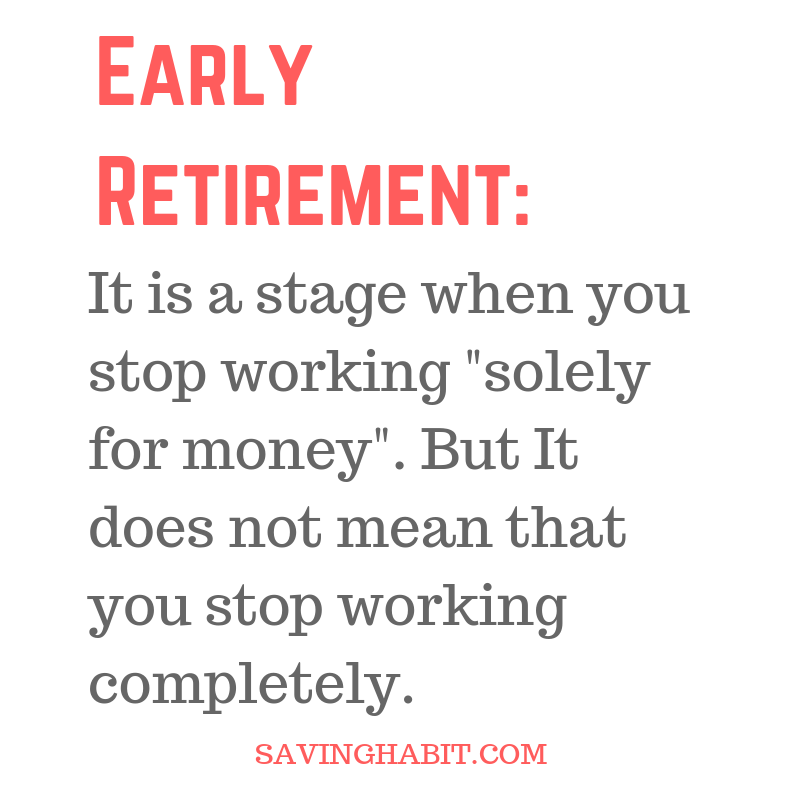
  • At age between 30-50 when you are able to meet all your living expenses through returnsย from investments like Real Estate (rental income), Mutual Funds, Stocks (dividends) etc. Also known as passive income.
  • So you donโ€™t have to actively work anymore to meet your expenses.
  • You live on investment returns post-inflation so your corpus will last forever beating inflationโ€ฆtheoretically.

Early Retirement in Practise

  • In reality people understand that if you retire early at age 30 or 40, you have 50-60 years to live after retirement.
  • So, to be safe and not bore to death :-)Early retirees develop a skill or hobby that they enjoy and which brings some cashflow to supplement their Retirement corpus.
  • So, most Early retiree do work, but in alignment with their life goals for example:
    • To do something they love
    • To earn money without stress & more work-life balance
    • To lead a healthy & active lifestyle

Early Retirement Meaning

Read more on The basics of Financial Independence and Retiring Early (F.I.R.E)

Disclaimer : This article is purely the authorโ€™s personal opinion. The author is not a certified financial planner. Seek the help of a certified financial planner for your individual situation.

Without further digressing let us get back to the business. If you have read up until here then you are really looking forward to Early retirement in India. We will tell you exactly what you need to know. Keep reading.

Math Behind Early Retirement

When everyone works till age 60, how can someone retire at age 30 or 40? Math is simple.

  • Invest a large enough Early Retirement Corpus in assets such as Equity, Debt and others which give you average annual returns of anywhere between 9-10% before inflation.
  • Assuming inflation at 6%, you are left with-3-4% returns after inflation to live on.

How Big Should Be Your Retirement Corpus?

(Not convinced you can save that much money, keep reading. We will tell you how to do it. And also share stories of two people who have done it)

  • We are targeting 25X as a starting target but will be most comfortable hanging our boots fully when we reach 40X.
  • However, we may take sabbatical or travel the world once we reach 25X. Check out our Semi-F.I.R.E lifestyle in Goa.

Making sure your Early Retirement Corpus will Last your lifetime

You have spent a decade or two saving up for your early retirement. Now how to be sure if you have saved-up enough or not?

“Safe Withdrawal Rate” answers this particular dilemma: How much can you spend in Early Retirement based on your savings.

In our blog post How long will your money last in Early Retirement we introduce our reader to a concept called “Safe Withdrawal Rate” (SWR).

SWR is a conservative estimate of how much you can safely withdraw annually from your nest egg without exhausting it completely before you die.

SWR approach balances between you having enough money every year to live comfortably after early retirement without depleting your corpus prematurely. Share on X

Not convinced that Early Retirement is possible in India? Markets are too Unpredictable, what if something goes wrong etc…

Our Experiment Shows Early Retirement is Possible in India

We did an experiment in our blog post How long will your money last in Early Retirement.ย Where we assumed:

  • 50/50 stock/debt portfolio
  • Person retired with 25X corpus of 3 crores, based on Rs.12 lakhs annual expense.
  • Withdrawal Rate is 4% ย in all scenarios

Tested these assumptions on different portfolio return:

  • 2% Real Rate of return*-ย 3 crores lasted for 34 years.
  • 3% Real Rate of return-ย 3 crores lasted for 42 years.
  • 4% Real Rate of return-ย 3 crores lasted for 64 years.

For detailed experiment visit our blog post How long will your money last in Early Retirement.

*The inflation-adjusted returns is called as โ€œReal Rate of Returnsโ€.ย 

5-Steps to Achieve Early Retirement

  • STEP 1- Target 50% Saving Rate

How to create a Nest Egg for Early retirement

The biggest difference between Traditional Retirement and Early retirement is Time. If you aspire for Early retirement you have less time to accumulate your retirement corpus or Nest Egg and many more years to live on that nest egg. Share on X That is the reason most Early retirees save aggressively at least 50% of their incomeย early on in their life instead of doing a small monthlyย SIPย with the goal of retiring in old age at 65.

50% savings rate reduces the time to retire.

reason behind the 50% savings rate
Why 50% Saving Rate?

This is the simple idea behind Early Retirement before inflation & investment returns even enter the picture.

  • STEP 2- Lower your Expenses

This is the only thing under your control so tackle this first. Analyze your lifestyle using apps like Spendeeย to cut down wasteful spending without beingย โ€œpenny wise and pound foolishโ€.

For example: In our house we use the internet for entertainment so no T.V or cable expenses, we mainly eat home-cooked food so our eating-out expenses are low, we do yoga at home so no gym fees, we own high-quality phones & laptops that are expensive but we maintain them carefully for years so they work out cheaper in the long run.

It took us almost 3 years to systematically reduce our spending without feeling deprived. Take a moment to think what are the top 3 categories where you could get the same value but for way less money? Share on X
  • STEP 3 โ€“ Increase your Income

If youโ€™ve cut all wasteful expenses and are still not saving enough then your only option is to increase your income. Your early retirement goal gives you clarity and urgency to do what is necessary to get that promotion or better-paying job Share on X

It will not happen overnight but you can work towards it purposefully now that you have a time-bound reason.

  • STEP 4 – Get out of Debt

Early retirement is about creating passive income in the future.

Debt does just the opposite. it eats into your future cash flows. So, debt is an enemy for Early Retiree. Till the time you crush your debt, you can not become financially independent or achieve Early retirement.

Another reason is debt is expensive. For example: Say you have a 36% annual interest Credit Card and an outstanding balance of Rs.1 lakh on it. If you donโ€™t pay back the debt for 2 years then the credit card balance will double to Rs.2 lakhs.

If youโ€™ve boughtย a house on exorbitant EMI at an early age, you need to first crush your EMI. If you have an education loan, learn how to crush education loan.ย 

  • STEP 5- Build a Side Hustle

What are you planning to do with 2000+ hours that will free up once you quit your job? Plan a /part-time/seasonal side-hustle generating cash to cover your expenses partly/ fully after you retire early. Share on X

This will reduce your worry if any regarding the safety of your retirement corpus plus keep your mind healthy and entertained. In our blog post Want to Retire Early to Travel the World? we share a few ideas of creating side hustle/passive income.

  • BONUS:-) STEP 6 โ€“ Work as a team with your spouse/partner

A couple can have different money habits, but they have to agree on their financial goals to be successful. Share on X

Get your spouse/partner on board and work together as a team.ย  Read our blog post on how to get your partner on board with your early retirement goals.

If all you want is a couple of years freedom to try your hand at a new career or business, try a mini-retirement like we didย instead. If you are debt-free and your spouseโ€™s income can take care of expenses, one of you can quit your job with the safety net of your spouseโ€™s income. If you succeed in your venture and are able to cover expenses then your spouse too can quit their job to follow their dreams. This way both of you can make money doing what you like. Even if you fail in your venture, you can re-join the workforce & try again later.

Why Early Retirement?

Early retirement is not a luxury but Necessity these days

Real-life case study:ย ย Headline news about all the 45-year old mid-level managers at TCS/Cognizant/Infosys getting laid off because their industry considers them obsolete and who probably wonโ€™t get another job at the same salary for at least another 3-4 years. An emergency fund of just 6-months to 1 year will not help in this case. These folks have been forced to take early retirement.

Companies won't think twice before hiring a younger person with a lower paycheck to replace higher-cost employees. So if you are not absolutely indispensable, Early Retirement should be your back up plan. Share on X If you are not ambitious to achieve it at age 30, age 45-50 makes a convincing case.

5- other reasons for Early Retirement

In Our Blogย Top 5 Reasons to be Financially Independent and Retire Early (F.I.R.E)ย we talk in details of other convincing reasons to retire:

  1. Because you can!
  2. Freedom, Courage and Peace – Life keeps throwing curveballs at us, huge retirement corpus at young age is like a massive safety net you can fall back on when things go south.
  3. F.I.R.E enables your money to work for you- Saving such big corpus early in life provides good base for your money to multiply and grow
  4. Practise for full retirement- Scaling down your work by 50% by age 40 is a great way to get a preview of whatย โ€œfull retirementโ€ย will look like at age 65. You will get a lot of wake-up calls mostly around the state of your health, investment returns , wasteful expenses and whether you really have any true passions in life or were you just lying to yourself about โ€œdreams & passionsโ€ to mentally escape from job stressย ๐Ÿ˜‰ย So while planning for Early Retirement also work on your passion on the side to prepare yourself for the post-40 life.

But Let’s be honest, Early Retirement is not for everyone. some people love their jobs and they want to continue working till possible. In that case, you can at least strive for Financial Freedom.

For everyone else, Early retirement could mean so many things. Here are the Top 10 things you can do in Early Retirement

Our Early Retirement Journeyย 

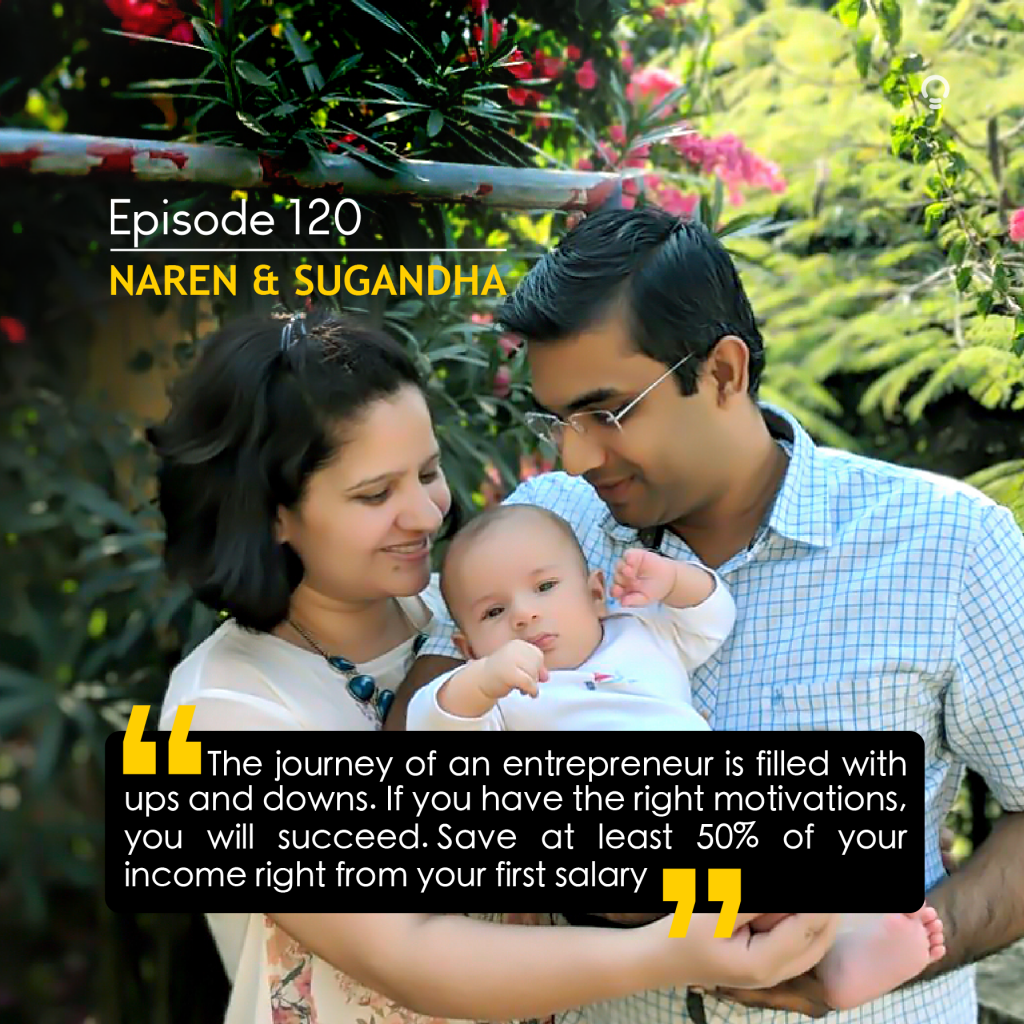
Saving habit family photo
Our Family. Photo Credit- our dearest friend G
  • In the year 2014, we took a calculated risk to quit our jobs and start own business.
  • At that point we had zero debt, owned an apartment and ย 7 years worth of expenses saved up.
  • Fast forward into the present- our business is a success. ย Business income fully covers our expenses and savings rate is climbing slowly towards 50%.
  • We realized if with 7-years worth of savings we can create such a fulfilling life. 25 times savings will take us to an epic level of freedom and security.
  • That is how we got glued to F.I.R.E.
  • After achieving Early retirement Naren may take up a job at a non-profit at a much lower salary. Sugandha is working on her own and wishes to continue doing it.
  • We live somewhat a frugal lifestyle. Check out our current lifestyle here.

So what do you think? Can you also do it? or do you need some more motivation?

Early retirement Success Stories in India

Please check out success stories of Two Middle-Class Indian Families who are very close to achieving Early retirement.

Early Retirement Interview: Mahesh is 5 years away from claiming Early Retirement

Early Retirement Interview: Anil from Pune is 4 years away from Financial Independence

If they can do it, we can do it so can you.

Frequently Asked Question related to Earlyย Retirement

FAQ 1: What about saving for my childโ€™s college expenses if Iโ€™m saving first for my early retirement?ย 

We have shared our strategy here-ย Our Plan to Fund Kidโ€™s College and Recommendation.

FAQ 2: Should I buy a house first or save for early retirement?

FAQ 3:ย But we want to do extended travel frequently. Thatโ€™s why we want to retire early and stop working!

Think win-win: Once you achieve financial independence you can quit your job and travel for say a year. ย After a year of travel, ย you can recharge both yourself and your bank accounts by returning to the job market for a couple of years to work on something you enjoy (maybe something related to travel!). ย Then travel again. Repeat the process until your 60s by which time hopefully you would have traveled everywhere you wanted to and your compounded retirement fund will be waiting for you!

——————–Let this be an End to a new beginning-———————

Ask us any questions or just drop us a hello!!!

We love to hear from you!

ENJOYED READING THIS BLOG POST ?

Subscribe by E-mail for more awesome information on Early retirement. We publish one new post every week!!! It’s Free!

Show your love on social media:

If you like our blog posts! please do LIKEย and SHARE it on facebook, twitter or WhatsApp!

[Life Update] Taking a pause from writing

Good news is we are ok. We sincerely hope and pray that this post finds you in good health.

This post is late by a year but I felt like I owed all of you a proper update for all the positive support you’ve given us over the years. Like many of you, the COVID crisis forced us to adapt our work and personal life leaving very little time for other activities.

Quick life updates:

  • I’m starting my forties this year ๐Ÿ™‚ So working on my health is a top priority for me.
  • Our son turns 3 this year! He is growing up in lockdown and has started online play-school. Most of our time is spent parenting him in shifts.
  • Our software business took a hit at the beginning of the COVID crisis with many customers cancelling or asking for payment deferrals. It was a stressful time when I honestly thought it will unravel quickly. I clearly remember both of us looking at each other calmly and calculating how long our emergency fund will last. So you can understand why updating this blog was the last thing on my mind.
  • Luckily for us, business has bounced back and has gone on to do even better than we expected.
  • For the next couple of years, we only want to focus on the two most important projects in our life right now : our son and our business both of which are poised to grow fast.
  • With that in mind, we don’t plan on updating this blog until we get a breather. But don’t worry, this blog will still be up and running.

Financial Lessons learnt during this crisis:

  • Short Summary of Lessons Learned: Invest money with expert help, Invest more in relationships, Invest more in skills, Invest more in health. Keep growing.
  • Long Story:
  • From a financial standpoint, this has been a stress-test of all the bookish theories that everyone including myself have been spouting about Financial Freedom & Financial Independence. If our financial situation had become really bad during this crisis, then only our savings would have come to our rescue. So for me that answers the question of whether we were correct to save a lot each month.
  • Having our equity portfolio drop by 50-60% last year was an eye-opener for us. So we hired a Financial Planner this year to audit our investments and asset-allocated from equity to debt for the first time. Our portfolio is very conservative now and our return expectations are also much lower. This means our monthly SIP is much higher. I recommend you also take the help of a financial planner. Blogs like ours are good to feel inspired and start the journey but to truly secure your financial freedom, get the help of experts. You can find a fee-only financial planner here. The fee is affordable and for most self-disciplined people it is a one-time evaluation.
  • I’m now mostly at peace with our Financial Goals. I don’t really stress that much or check our portfolio performance daily like I used to! In fact I don’t even read Personal Finance articles anymore. I just SIP the amount recommended by our Financial Planner and only plan to check it once a year to asset-allocate. I realised that I was expecting too much returns from equity too quickly worrying constantly about how to squeeze expenses to put more into SIP. I was operating under a scarcity mindset of making do with the money we have instead of a growth mindset of figuring out ways to make more money.
  • In fact, I’m so zen right now that I don’t plan to retire early anytime soon. I’m in a very confident and positive frame of mind that I feel like I can keep working on things I like for the rest of my life and keep making decent money. I credit the feeling to having a financial safety net for my family and having weathered multiple crises in the past 20 years. I feel that even if everything goes down the drain tomorrow financially, I can still get back up and prosper again. In that sense, I feel mentally Free already and I believe this is a by-product of pursuing Financial Freedom.
  • This COVID crisis also made me realise that Money cannot solve all problems. If all the money in the world cannot get me an oxygen cylinder or ICU bed or a vaccine, then what’s the point. Thankfully we were reassured by an excellent support system of friends, neighbours, relatives and good samaritans online arranging oxygen, hospital beds and food. I had to self-isolate earlier this year due to COVID-like symptoms and my neighbour who was away, asked me to use their empty house to quarantine. Thankfully I tested negative for COVID and it turned out to be a nasty viral infection. It was a scary time and we could see everyone around us pitching in to help the 3 of us. We will be investing more in meaningful personal relationships and actively contribute our time & energy in any small community that we are a part of.
  • During the peak of the 2nd wave, we donated more money in April and May than what we had donated in the last 7 years total. I now realise that the money you give away will come back to you many-fold. Both in giving you a purpose to make more money and in making the world a more liveable place. I do feel a bit ashamed and perplexed that I did not have the confidence to regularly donate even a tiny percentage of my monthly income towards charity all these years when I was so focused on financial freedom for myself. In fact, I now consider the ability to donate regularly to charity as an indicator of my financial health and confidence in making more money.
  • oh! Increase Life Insurance and Write a Will. Courtesy of my health scare for shaking me out of this inertia.

In Conclusion:

I could keep on writing about so many different angles to Financial Independence/Early Retirement, but there is only one fundamental message : Save atleast 50% of your income each month”. If you cannot cut your expenses to 50% of income then the logical next step is to work on increasing your income instead. Do this and your Quality of Life will improve way before you even achieve your target amount as my personal experience shows above.

Wishing that all of you achieve Freedom & Happiness in life.

Naren & Sugandha.

P.S: Do leave your personal learnings as comments. I may not reply due to time constraints but I’ll definitely read them.

Blunt Truths for 20-year olds in a Recession

4

I got body-slammed by the 2002 dot-com recession and took years to recover personally and professionally. One aunty even told my mother to her face that “Computer Science is dead! even U.S people are coming back to India jobless. How is your son going to get a job?“. This was in 2002. The 9/11 attacks had just happened. We had exactly one IT company that came for a campus interview and then cancelled all the job offers as the recession worsened. My batchmates who studied Computer Engineering went to work at call centers. I was too embarrassed to even sit for a call center interview on campus. But many of my peers did not have the luxury of being choosy. Others worked at low-paying jobs from morning till night. Still others like me “escaped” to do a second degree. Basically it all came down to each family’s finances, risk appetite and plain luck.

I’m close to 40 years old now and the memory still hurts. I want to share some of my learnings when a recession happens in your early 20s. No news article will talk about these blunt truths. Let me list them out first and then share some ideas on how to make the best out of a bad situation and still come out on top.

Blunt Truths about an “Indian” recession:

Yes, you did everything parents, professors and society asked you to do : Study, Study, Study. Yet, here you are jobless.

  1. Campus placement offers will be cancelled if they haven’t already. Most students who receive campus placement offers are going to be jobless in 6 months when the company withdraws the offer. Irony: The same IT company that did this to our batch 20 years back is doing it again this year. Saying in the headlines that they will hire everyone who was offered a job and then silently undoing it off-camera 6 months later close to the join date.
  2. If you are a girl in your 20s and without a job, then you are most likely getting married off soon. So high likelihood of breakup with your boyfriend unless he has a secure job by Indian Parent standards. Indian Parents are very risk-averse and will panic in a recession like this one. If you are a girl who does not want to get married off, try living away from your parents by getting any job/internship or a higher-education that takes you away from home.
  3. If you are a guy who is jobless and living with your parents, you will be under tremendous pressure to get any job even if unrelated to your major or do higher studies to keep up appearances. Most of this is just parental pressure and the “aunty/uncle” pressure.
  4. If you think you can ride out this recession by doing a Masters degree or some higher degree, everyone else has the same idea. So competition for the limited seats, scholarships and jobs after 2 years will be fierce.
  5. For the rest of your life, your salary will be much lower. This is because you will be taking your first job at a low salary in a recession. Since increments are based on your previous salary, your absolute salary will grow slowly even when the economy recovers. So your junior might make more money than you since they will be hired at a higher starting salary in a good economy.
  6. Your self-confidence will take a beating. You will suffer from Imposter Syndrome in your professional life.
  7. Mental Health will go for a toss. Constant Stress and Hopelessness combined with a lack of support system will take a toll.
  8. It’ll slowly dawn on you that your out-dated college education really did not prepare you to get a job. In good times, students get hired inspite of their colleges but in bad times is when you can see the true worth of a college.
  9. If we are being honest, you knew most of this already while you were in college or in the workforce. You just didn’t think it will happen to you. But the musical chairs stopped only for you not others who were equally unprepared. If you are truly interested in your field of study you can use the spare time now to learn the skills needed by your industry by looking at the job postings.

Silver Lining:

The recession of 2002 was over by 2004 and an economic boom started

  • The recession of 2002 was over by 2004 and an economic boom started mainly in IT, Telecom, Financial Services and Real Estate
  • Google went IPO in 2004.
  • Facebook was launched in 2004.
  • iPhone was launched in 2007.
  • A SaaS, Social Media and Mobile Apps startup boom started in the U.S and later spread to India as well. Example: Flipkart, Ola etc. This meant more IT outsourcing jobs in India
  • I turned out O.K. Did a masters in U.S right out of college, worked for an MNC, then at a startup and returned to India to start my own software business in Goa.
  • My friend who worked in a call center for those 2 years applied for a U.S Masters program. He works in California now.
  • Most of my college batchmates have landed on their feet here in India and all over the world. Some are even entrepreneurs, research scientists, CEOs etc. 20 years later there are no stories of computer engineers begging on the street as many aunties/uncles had cynically predicted.
  • But the mental trauma we went through and all the lost opportunities/money is real. I’ve listed them in the blunt truths above. Like they say “What doesn’t kill you makes you stronger”. I would like to think that we are more resilient than someone who has never seen a recession before.
  • Our “Computer Science is dead” aunty is probably now using WhatsApp on the computer in her hand (a.k.a phone) without a hint of irony and sending out fake news to scared parents of youngsters. Maybe this time she will say “Office work is dead/Medical Science is dead/Human Progress is dead” or something ignorant.

What you can do right now:

When life hands you lemons, learn to make lemonade

  • Don’t believe the doomsday news about jobs not being available. Some are firing while others are hiring. I myself am actively hiring for my software business paying market salary. I’m unable to find good candidates who have the skills and experience.
  • Most colleges suck at campus placements even in normal times. Read this article on how a campus placement actually works in IIM Ahmedabad and why they bag the best offers. If your campus placement cell does not work their ass off like mentioned in this article then you are doomed. So force your campus placement cell to get their act together and canvass the HR of companies more aggressively. Make a list of all your college alumni and where they are working these days using LinkedIn. Start contacting them for interviews.
  • Even if you don’t get placed through campus, there are a ton of opportunities to apply for jobs online – LinkedIn, Indeed, Monster, Naukri etc. There are many small software companies that offer a trainee software position these days. See Example This will help bridge the gap between your out-dated education and skills actually needed by the industry.
  • If you were already working but have been laid off recently, make sure to post your skills and availability on your college alumni group on LinkedIn/WhatsApp. A lot of small software companies and non-profits are eagerly looking to hire talent previously cornered by corporates with their untenable promise of “job security”, “career path” etc But you have to be willing to lower your pay & perks expectation to bag these.
  • Only take up a low-paying job if it is going to help you make more money down the line or connects you to powerful people. For example : If you join a startup or small outfit you will be paid less but you will learn a lot more in one month than you will in corporate in a year. That will help you command a higher salary when you change jobs. You can do an unpaid internship if it helps you connect with top people in the industry on a “first-name” basis like working at NASSCOM, Niti Aayog, Smart City initiatives etc
  • It is better to do “job-guarantee” courses offered by the industry instead of useless higher education degrees offered by colleges. Because this recession might not end by the time you graduate from these colleges and you’ll be left with a big student loan and no job.
  • Only go for higher-education if the ROI is high. Example: don’t pay a ton to do an MBA at a third-rate college. Instead try to get a scholarship or do a short course at a prestigious place like IIT/IIM etc. This will add prestige to your resume without burning your pockets. I myself studied at a mid-rank state school in the U.S where the fees was very low comparatively but our lifetime earnings boost was order of magnitude high.
  • Try to do tangential degrees/concentrations instead of just the popular fields. That will ensure that you will get a scholarship & admission easily. You can always pivot back to the popular field when it comes time to get a job. True Fact: you will find many IITians who studied Metallurgy in the Software industry.
  • Many students who apply for higher education don’t know that they qualify for many scholarships. All they have to do is apply.
  • Entrepreneurship is a good option provided your family is supportive. Even re-selling designer masks online will mint you a lot of money in this time. But the greatest obstacle for youngsters to do business in India is parents.
  • If all else fails, you can Freelance on sites like UpWork. You can get hired hourly instead of on a permanent basis while putting your education to work earning money and a portfolio.

Preparing for the next recession 7 years from now

Invest in 3S : Skills, Savings,Social Network

  • Recessions will happen every 7 years or so. It is simply a matter of what goes up coming down in the economy. India’s economy was already in bad shape before COVID made it worse meaning you would have had a recession any way.
  • Invest continuously in 3S :
    • Skills – to get you a high paying job. if recessions are frequent then you need to make a lot of hay while the sun shines
    • Social Network – knowing all the right people in all the right places will help you find a job even in a recession. This is pretty much the only reason everyone is crazy about getting into IIT/IIM
    • Savings from a high paying job to achieve financial independence from a job. Read this blog on achieving Financial Independence using just your job salary.
  • Hold your immediate boss accountable for your career growth. The deal is : you get him promoted and he/she promotes you. Don’t stick around with a boss who does not have the leadership quality of being demanding yet nurturing.
  • Keep switching jobs for higher salary until you close the pay gap caused by graduating in a recession. If your boss is smart he will get promoted and promote you along with him.
  • Never be shy or embarrassed to share your salary with friends or colleagues so you know if you are being underpaid and either confront your boss or switch jobs.
  • Raise your hand for big assignments in spite of your confidence level. You’ve already seen the worst ie. being jobless in a recession.
  • If you don’t know something at work, don’t pretend. Instead loudly say “I don’t know that but I’ll learn it in a day/week and get back to you” That’ll give you the confidence to rid you of your Imposter Syndrome at work. Basically you’ve already let everyone know that you don’t know something you should have known. So there is no risk of anyone “finding out that you are a fraud”. Once you’ve been humiliated by joblessness there is nothing else to be embarrassed about. Does wonders to your self-confidence!
  • Try to think independently of what your parents want of you. Chart your own course based on what’s good for you and your Life Satisfaction.
  • Never ignore your mental health as it will severely affect your ability to do your job and be happy in life. That unexplainable sadness and disinterest could be depression. That sleeplessness could be from Imposter Syndrome. That paranoia could be from a stressful job loss. You can now try affordable online therapy in India. Parents or Friends are only good for bad advice.
  • Lastly, read 7 Habits of Highly Effective People. It will teach you more about how to get what you want from life than anything else you’ve been taught so far. You will read it and feel “If only I had known all this sooner….”

Working from home effectively without losing your mind

0

My wife and I have been working from home for nearly 7 years now and have a few learnings to share. For the first time nearly every white collar worker in the world seems to be working from home and spending daytime with their children and family members. Courtesy: COVID19. This can drive people crazy after the first few days of novelty. Work from Home is only productive when there is no one else in the house and no one knows you are home including coworkers, neighbours and delivery-men.

Work very early in the morning or late at night to be most productive

This is the only time when no one will disturb you — including your child, spouse, delivery-men, house-help or neighbours. It will be quiet and you can get a lot of work done if you simply get up two hours early or work two hours after everyone in the house is asleep. Frankly 4 hours of solid uninterrupted work from home is equal to a full day’s work at the office with commutes, meetings, chit-chat, coffee breaks, internet browsing etc Best part is you can spend the rest of the day without stress knowing you’ve already put in the work.

Don’t reply to Work Emails, Phone calls, Chats etc immediately

It might be tempting in these days of Slack, WhatsApp and Email notifications to reply as soon as possible to show that you are working. But these are time-sinks that prevent you from spending your peak energy on your own work output. Handle emails in the afternoon when you are low-energy or bored. Check chats once an hour or two. Schedule calls when you are doing some prep-work in the kitchen. Same with personal calls from friends and family.. don’t take them during your work hours. If anyone tries to guilt you about it.. tell them you are working.

Work in Shifts… handle child & house during your spouse’s work hours and vice versa

This way both husband and wife get to work uninterrupted. If someone rings the bell or food needs cooking/prepping then it is the person not working’s responsibility to handle it. Bonus is getting to spend time with your child while taking a break from work or getting some food prepared before anyone gets irritable from hunger

Split the household chores and stick it on the fridge

Check out this comic strip that explains what happens when only one person is doing all the chores in the house. It is actually a feminist comic but even modern feminist women are guilty of not doing their share of chores as they seek to avoid the “stuck in the kitchen” trap that befell their mothers and grandmothers. Best to split the chores ahead of time and stick a note listing it out on the fridge. For example: Sundays I’m responsible for our toddler from morning till breakfast time – playing, feeding, bathing and cooking breakfast, then my wife takes over our son and cooks lunch and feeds him, then I take over after his afternoon nap until evening playtime, wife feeds him dinner while I bathe him then I put him to bed at night while wife loads the dishwasher and orders food online. Work happens in between chores.

If something needs fixing around the house don’t jump to fix it during office hours.

Say the bathroom tap is leaking or dishes are piled up near the sink. Don’t immediately jump in and waste your time fixing it. These are time sinks. There is never a shortage of things that need to be fixed around the house. You fix one and there is one more you’ll notice. you have to be very protective of your limited time and energy. Reserve your energy for work and family. Fix house stuff on the weekends only or during downtime from work.

Arguments are inevitable. Argue -> Resolve -> Forgive

Working in separate offices used to provide a buffer whereby friction points were separated by time and space. But now with both of you working from home there is more chance of friction sparking a couple’s argument perhaps in front of your child. Maybe your work call went longer than expected at the exact time your toddler decides to cry uncontrollably and your spouse needed your help. Maybe you snapped at your spouse because they left the kitchen dirty.

No couple who deals openly with their issues go long without arguing. I have no solution except to spend time daily as a couple without work, gadgets and other family/neighbours intruding. Talk about anything other than work or negative news. If you want to share any specific advice that worked for you please do so in the comments below.

Don’t check the news or social media or your investment portfolio during work hours

We tend to do things we don’t do at the office like opening news portals when we are working from home. ideally don’t read the news at all during the day.

Here’s a good article to cure your news-craziness : How to Stop Freaking Out About the Coronavirus But Stay Safe

Exercise or Meditation is your alone time

All this close proximity to family might leave you with no time for yourself to gather your thoughts. Exercise is your solution. You can walk outside your house/terrace or up and down the stairs or pick up a yoga/cardio video from youtube to do in your room. Meditation can really relieve your stress in these stressful times. Here’s a simple way to start meditating daily.

Take a 20 to 30-minute nap in the afternoon to feel fresh for the evening

I take a nap a little after lunch. Naps are proven to refresh you in the same way as night-time sleep. Problems are solved faster and mood is less irritable after a nap

Spend evenings together as family without T.V or phones

Now that you don’t have commute to worry about, you can spend the evening commute time instead with family. Ideally from evening to dinner time without any gadgets like T.V or phone. This way you don’t feel like you’ve been working all day. You need the break and fresh air.

Bonus tip: Play everyone’s favourite music when you are all together to keep everyone in a good mood.

Money & Love- How many years of extreme savings can your spouse take?

0

So you’ve managed to convince your spouse about Financial Independence! Any time they have doubts, you forward them relevant articles from FIRE blogs. Every now and then a FIRE couple is featured in the news or magazines and you forward that also with the unstated opinion that “so many people cannot be wrong”. But the truth is things can go horribly wrong and this Valentine’s Day is as good as any to re-focus.

Can extreme savings lead to divorce?

The FIRE community may be transparent about their finances and life goals. But they tend to sweep uncomfortable truths under the rug like for example the impact of extreme savings on relationships. A casual search on reddit FI throws up posts on divorce , breakups , regret and late realisation but the comments are mostly how FI/RE is not the main cause and the relationship would have broke down anyway. While these relationship problems happen to the general population as well, extreme savings adds extra strain to a marriage. My point of this post is so one does not wake up one day and wonder what happened to their life just when you thought all was going well. If there is one thing that can derail your FI/RE goal it is the marriage imploding. So if you are the kind who likes to “mitigate” any risk to their Financial Independence goal, then treat this as a “relationship risk” and nip it in the bud. If you are honest then you’ll forward this blog post to your spouse even if it makes you uncomfortable ๐Ÿ™‚

4-5 years is the maximum your spouse can tolerate extreme savings

Year 0 : You(typically male) get super-excited about FI/RE and consume all the words written on the internet about it.

Year 1 : Convince reluctant spouse(typically female) to save 50% of household income through sheer repetition and math. Maybe bank one person’s income for FI/RE and use other person’s income for expenses

Year 2 : You are happy that Spouse is on-board. Spouse is also happy because savings seems like what responsible people do and they are learning so much about personal finance.

Year 3 : Honeymoon period ends. Either buying a house or a kid is in the horizon. Spouse begins to suspect that you are skimping on other important life goals like house, kids etc due to single-minded focus on FI/RE. You brush off their concerns with more repetition and math about how you will reach FI/RE in just the next 7 years. Spouse asks: after 7 years, then what? You reply: I will retire from work. Spouse asks: what about buying a house and funding kids education? You have no answer.

Year 4: Fights erupt regularly over saving and spending especially when the extreme savings is an artificial constraint on spending or investing elsewhere. Your whole FI/RE project that looks good on Excel is turning out to be quite messy in real life.

What can you do?

Start Listening :

If you’ve gotten to this point in your relationship, you have to face the reality that you’ve reached a fork in the road. To the left is marriage and to the right is your FI/RE goal. It is one or the other at this point. So start listening carefully to your spouse. Are they saying that you are penny-pinching for even small luxuries or are they saying that extreme savings is preventing them from reaching their life goals.

Beat a Tactical Retreat :

If you want to go fast, go alone;

BUT If you want to go far, go together.

African Proverb

If you choose the FI/RE fork you are guaranteed to mess up the marriage. But on the other hand if you choose the marriage fork there is a high chance that you will still hit your FI/RE goal. Here’s how: Frame your spouse’s life goals in FI/RE terms. For example: Say your spouse wants buy a house instead of pouring all savings into FI/RE. Think of it this way: You will have to buy a house to live in retirement anyway and buying a reasonable house will eliminate the rent expense which will reduce your overall FI/RE target. Why not try and crush a house loan within 7 years using the same FI/RE extreme savings method? Marriage saved. House bought. FI/RE target reduced. win-win-win. Unlike regular people the EMI will not be a sword hanging over you every month as you have a large safety net saved up so far.

Build the life you want, then save for it

I borrowed this heading from this reddit thread. You don’t have to read the thread to understand this logic. Frugality is presented as the foundational principle for FI/RE. But I’ve kept hammering the point that you can’t be frugal during saving years and hope to live lavishly during the retirement years. The math does not work that way. Your success will be more sustainable if you truly understand your lifestyle expenses and save for “that” instead of some fudged Excel target. If your life-partner is telling you strongly that you are ignoring major lifestyle expenses then listen to them.

Stop hating work and Increase your Income

Just because you stop saving for FI/RE and instead buy a house or fund your kid’s education does not mean you’ll have to abandon your FI/RE goal. The solution is to increase your income and keep pumping the surplus towards your corpus. A lot of FI/RE aspirants hate their jobs and that’s the primary motivator for FI/RE. Have you considered earning extra income on the side either using your existing skills or your passion? Have your considered brushing up your skills and applying for a higher-paying job? Have you approached your boss and asked them what you need to do to get a promotion in the next 1-2 years? Your FI/RE corpus saved up so far will give you the guts to take these bold steps. Now you have your spouse supporting you 100% in these bold moves since they know you are doing it for the family. You can then encourage your spouse also to increase “their” income in a similar fashion to meet all life goals faster and still be on course for FI/RE

What does all this mean for your FI/RE goal?

If you can only save for 4-5 years after marriage and assuming you’ve saved for 4-5 years as a single person before marriage, then you’ll realistically only hit Coast-FIRE – meaning you would have already saved up for retirement at age 60 in your 30s itself. But it would not be the 25X you had targeted. But this is still much better than 95% of the working population and the safety net is still there for 10 years if not 25. You are better off than you realise!! If you don’t feel confident at this achievement of 10X then you will not feel confident even with 25X

Conclusion

I still recommend saving for FI/RE corpus as the first asset you should build instead of a house which is a dead-weight career-killer in India. Because FI/RE gives you the freedom not to worry about money freeing you up for better things in life. Having said that, Life is all about balance. So don’t focus single-mindedly only on achieving FI/RE neglecting other important life goals. Think back to why you wanted to FI/RE in the first place and whether the FI/RE journey has already given you that comfort and confidence. Think of achieving other life goals as re-balancing your portfolio into multiple assets one of which is a marriage you can bank on in good times and bad.

Happy VALENTINE’S DAY ๐Ÿ˜‰

Make more money this year by making 5 small changes

0

Reading or hearing about how other people are doing better than you is frustrating especially when you started out similar to them. But the past is the past and one can only fix the future. Starting this year, you can make few small changes to your life and allow them to compound increasing your quality of life. None of them are radical or original, in fact none of them has anything to do with even money.

Stop reading or watching the daily news … completely

If you want to make more money, you need to carve out more time from your already busy life. Most of us read the news or catch up on sports/entertainment/social media if we get just 5 minutes of free time while waiting for a work call to begin or just before sleeping at night etc. 5 minutes turns into 1 hour because the media knows your brain more than you and tempt you with just one more supposedly important article you should read. I also suffer from this bad habit. So this is my main resolution this year : completely stop reading daily news in any and all forms including discussing with anyone in person. Personally the biggest benefit is that I get a proper 7-8 hours of sleep since I don’t read on my phone before going to sleep so I wake up fresh the next morning.

I tried this “giving up news” experiment last year when my son was a new-born and I barely had any time for sleep let alone news. Amazingly I did not miss anything important and I had more time to read about parenting a new-born baby which is far more important than things outside of my control. On a side-note, if you are a father I recommend reading this Manifesto for fathers on how tiny distractions pull you away from family time.

Fix your sagging energy – it could be vitamin deficiency

Even after sleeping for 8 hours, I would feel tired and drowsy by 11 AM. In my corporate job, this would be my cue for a coffee break and then again at 3 pm and sometimes at 6 pm also. But my fatigue recently increased more than could be explained by sleep deprivation alone. A visit to the doctor revealed that I had really low Vitamin B12 levels. I now take daily supplements Vitamin D and Vitamin B12 and I can notice the change in my energy levels. Read this article for a good explanation of this epidemic in India. If you are a woman, you need to check if you have iron deficiency or a thyroid problem

I also take a 30-minute nap in the afternoon around 3pm. This helps me get out of my post-lunch sleepiness and I’m energised to work again. If you are at the office, simply shut your eyes, get comfortable right in the office chair and meditate for 20 minutes wearing a noise-cancelling headphone. Inform your boss and colleagues of this before-hand as workplaces can be conservative. You can even book a conference room at work for this purpose.

Current work culture requires you to work long and hard. Most of this is unproductively spent keeping up appearances. Solid work can be done in just 4 hours a day in a “Flow” state. My tip to get into a flow state is start working on the easiest task first thing at work. Before I know it, I’m in a trance state tackling complex work. That’s because small wins incentivise us into the work mode while a complex task can be off-putting.

The human body is like a battery. You need to recharge it efficiently and also use its energy efficiently to be productive and not be tired all the time.

Exercise daily or atleast start walking everywhere

As soon as I entered 10th standard, I was forbidden to play after school because it was supposed to make me “too tired” to study in the evening. I realised much later that this is a myth. In fact exercise helps your mind become even clearer allowing you to be more productive in a shorter time … again the “Flow” state. The problem is that a person who is just starting to exercise or play a sport will feel tired initially before they get used to the regimen. Then it is all benefit from that point onwards. My former boss would run a mini-marathon every day before coming in to work in the morning and he was the most productive person I’ve ever worked with.

Because exercise also releases feel-good hormones you will feel less need to consume junk food or junk entertainment to make you feel better after a hard day’s work not to mention the social aspects of friendship. You don’t even need to go to the gym – simply walk a few rounds in the park, load up a yoga video from youtube right at home, take the stairs instead of the elevator, walk to the grocery store and walk back with the heavy bags or play a favourite sport of yours.

Work on making more money when the world is sleeping

This could be early morning or late night depending on your preference. Now that you have spare time from not reading the news and being more productive at work from fixing your energy level through exercise and “flow” state, you are ready to make more money.

Spend an hour each day exploring ways to make more money using your track record and skills. Research what other people in your industry do to earn more money. Sometimes it might just be learning a new skill or even searching for a new job and understanding what you need to do at your current job to make the cut. Honestly you know best. But understand that spending an hour daily on your deepest needs will make you a happier person at work and life even if progress is slow because you know your needs are being addressed finally.

Publicly write and share your progress

This is not just for accountability but for visibility. One of my friends used to blog regularly about every new semiconductor chip that came into the market because he was interested in the new features. He would even predict the kind of features that a company like Apple is planning based on their including the chip in their next laptop or phone. This led him to jobs in the chip industry and frequent calls from venture capitalists interested in picking his brains.

Even this blog on financial independence has been linked from Times of India, Outlook Money, CNBC, Mumbai Mirror and The Goodmen Project etc just because we kept writing about our progress and learnings regularly every month.

You can start writing a blog based on your interests and cross-post it on LinkedIn, Facebook etc. Trust me – whether you seek a better career or want to start a new business or just want to make a social impact, your visibility as a person who knows what they are talking about will open doors for you.

A happy 2020 to you all!!!

1

A very happy New Years to all our readers and fellow F.I.R.E aspirants!!! We hope this year brings you good health, happiness and lots of wealth.

We could not share much on this blog in the past few months, because whatever free time we have we want to spend with our son. He is growing up very fast, and learning new things every day. It is a very exciting time for us as a family and we don’t want to miss out on anything:-) But we hope as he grows more independent we will have more time to us and we will resume our writting.

We are pretty much on track with our F.I.R.E plans. Although, having a kid is making it a challenge- our expenses have increased more than we expected. We are targeting to increase our income to accommodate our increased expenses.

In case you have missed, here are the links to most read articles on our blog in 2019:

P.S: we do have to reply to a few pending comments. we will do so at the earliest possible.

My extended paternity leave – perspective of an Indian father

3

Our son just turned ONE year! Only now I realise that I have been on an extended paternity leave for the last one year ๐Ÿ™‚ Both by choice and necessity, I’ve been a hands-on father with daily child-care like changing diapers & clothes, feeding, cleaning potty, cooking baby food, giving baths, helping put the baby back to sleep in the wee hours of morning etc.

At our son’s 1st birthday

My role models were the Indian fathers in my U.S friends circle who would do it as a matter of routine because there was no nanny or cook to help beyond the usual 6-month stint by each grandmother. Since we had our baby late in our 30s, our elderly mothers could assist only until our kid turned 6 months old. We had a pretty rough luck finding a cook and nanny and the ones we did find would quit after just a month or so throwing our newborn-household into chaos until we found the next one. So I was forced to scale down my work and get more involved in household and baby care given the unreliability of hired help.

Sugandha has had exactly 1 full night of uninterrupted sleep since Kabir was born a year back. I sleep in the same room as the baby so my sleep also gets disturbed except I don’t have to spend 20-30 mins every 2 hours breastfeeding the baby throughout the night.

KEY DISCUSSION POINTS IN THIS ARTICLE:

My Daily Routine as a Father of a one-year-old

I wake up at 5/6 am to take the baby, then when Sugandha took over around 8/9 AM I would do some work, eat breakfast, then sleep at 10 AM for an hour, then resume work from 11 till late afternoon, then take a late afternoon nap to get the energy needed to handle the baby’s evening routine of play, dinner and feeding routine then do some more work after baby falls asleep at night.

Our son a few hours old

Until the time our son was born, I never fully appreciated the flexible work hours & remote work afforded by my line of work – software programming. I’m now deeply grateful for this unexpected positive side-effect of our current lifestyle.

Work has taken a back seat

Has my business suffered as a result of my reduced productivity & attention? yes. very much ๐Ÿ™ Could I have made more money if I was working regular hours? absolutely! But like other fathers, I am acutely aware of time flying fast with our son. Some days I want him to be in college already so we can go back to the couple-life we had without sleep deprivation. Other days I want time to slow down so I can be present with my son in this once-in-a-lifetime phase.

The cycle of- Feed, Potty, Clean, Repeat…

Even with extended Maternity Leave, it does not seem fair to burden the mother with all the child-care work at home. Even the short time I help out at home it tires me out physically and mentally. No one talks about the marriage being strained by unending child-care duties during the day and sleep-deprivation at night for the first 2 years. MoneyMustache kind of talked about it. Maybe I was not paying attention. So be forewarned ๐Ÿ™‚

We currently have a regular cook and nanny, our son is eating solid food and has a predictable daytime schedule. Nighttime is still sleep-deprived. I’m ramping up at work. Our conflicts over who does how much child-care work have gone way down as a result of our current support system. Things seem to be getting to a new normal. Only time will tell.

(un)Support(ive) System?

I realise that I’m one of the lucky fathers to have the flexibility to spend time with my newborn son during the daytime on weekdays. One of my friends confessed how the early years as a father was all one big blur and regretted not spending more time with his children when he was away at work morning till night. My other friend only gets to spend time with his kids in the morning before school and on Sundays as he usually comes back from work late after the kids have already slept. Typically the child-care burden falls entirely on the mother while the financial burden falls entirely on the father.

I used to visit my sister’s kids in California for the holidays while I was still working in the U.S. I was amazed to see parents working in tech companies show up for their children’s school play late on a “weekday” afternoon. They would all show up with camcorder in hand to record their children singing or acting. After the play they would take the kids home, finish the evening homework routine with early dinner at 7 pm or so. Then login back at night to resume work till midnight. They would wake up late the next morning while the other parent dropped off the kid at school. Either they would head to work late in the morning or decide to work from home itself. My brother-in-law explained that as long as the work got done no one cared how or when you got the work done. This utopia was only in the Silicon Valley tech cluster in California. When I flew back after the holidays to the East Coast (New York/New Jersey) at my traditional company, work hours were non-negotiable and you had to show up in ironed formals at 9 AM whether or not you were up from 3 am to 5 am on pager duty fixing a production problem. Leaving earlier than 6pm or 7 pm was bad for optics even if you were going to login back at night to make up. Even tech startups in the East Coast would have a similar culture as their corporate counter-parts as opposed to the family-friendly timings of Silicon Valley, California on the West Coast

While everyone wants you to have kids, you are pretty much on your own when you have one:-)

Having a kid has made me realise just how unsupportive society is in general to new parents contrary to the public rhetoric glorifying parenthood. From hired help to the workplace, from close family to friends … you are on your own if you have a kid. If it is this difficult for the modern Indian working father, I can only imagine how much more difficult it is for the modern Indian working mother. All this lack of support has kind of put the brakes on us having more than one kid for now.

It got me wondering how parents with full-time jobs manage their parental duties. Especially where both husband and wife are working and don’t have grandparents nearby on top of unreliable hired help. It must be pretty brutal!

Excerpt from “Working Fathers need Balance too” that resonated with me:

Thereโ€™s already really a gender war going on among men, between older men and younger men.

Because if you look the millennials, who are coming up, they often have very different ideas of what it means to be a man to be reckoned with. These men have not only a different attitude towards their partner, but they also have a different attitude towards fatherhood.

The ideal of the nurturing father has really gained steam and itโ€™s shifted notions of fatherhood in very profound ways. Certainly when I was growing up, or even 20 years ago, being a really committed father was maybe showing up at a game, a performance, a play, not taking the kid to the 17 rehearsals that led up to the play.

But these younger guys feel that being a good father involves, at some level, being involved in their daily activities. And that ideal of fatherhood is inconsistent with the work devotion ideal.

The other thing, I think, that the younger men are reacting to is of course the economy no longer gives people the same deal as it did. Weโ€™ve seen massive, massive layoffs among very high-status white-collar workers, and that has also, I think, changed attitudes profoundly. And why should I completely sacrifice everything for a job that may ultimately treat me as disposable?

Tips for future parents who wish to take an extended break from work after child-birth:

Sugandha found shocking research showing that the first 2 years of a child’s development pretty much determine their emotional, mental and physical well-being & success in adulthood. Knowing this I would imagine most modern parents would wish to be more present in the first 2 years to lay this crucial foundation. If you wish to spend more time together as a family during the early years after child-birth, the hard truth is full-time work as an employee is incompatible with early parenthood. So if family-friendly work is not available then the only option is to create the opportunity yourself.

My suggestions below might sound impractical but sometimes life situations like job loss or health issues force your hand into taking an extended break from work to take care of your child. Then you might wish you had considered these options instead of relying on just Maternity Leave or simply assuming both of you would be employed.

Practice living on one person’s salary in the years leading up to the pregnancy

This is a good family-planning practice whether you plan to quit work or not after a baby. I personally know a family where the mother took maternity leave and soon after, the father lost his job for no fault of his due to the recession and could not find another job for more than a year with the recession in full swing. Say you are planning to have a baby after 2 years. Practice living on one person’s salary for 2 years before the pregnancy using the lower salary. Save the bigger salary towards your living expenses post-pregnancy. This way if the mother wants to extend her maternity leave for health reasons or if she wants to explore a different career path that is more family-friendly she can do so. Only after a baby arrives can you as a family assess the situation and decide whether returning to the same job post-maternity leave makes sense.

Ideally: Aim for financial independence by the time you have a child.

Financial independence is ideally suited for modern parenting with two involved parents because raising a child takes a lot of time and energy. It can be a challenge to do full justice to it along with a full-time job, especially in the first few years of a child’s life.

Fact is you cannot get any office work done during the first year of the child if you are pitching in meaningfully with child-care. Since high-earning couples these days are having kids late any way when they are already 30+ they have a greater chance of becoming financially independent by the time they have a baby.

Is 26 weeks of Maternity Leave not enough you ask?

โ€œIt takes 20 years, not 26 weeks, to raise a childโ€

Next best option: scale down work to part-time

Unless you are fully financially independent you should never quit working. because having kids is an expensive affair too:-). If you can afford to work Part-time is a good option. Working part-time helps you keep your skills sharp, bringing in money and you can easily re-join the full-time workforce later when your baby is slightly grown-up.

Even part-time work will not be possible for new mothers with a breastfeeding schedule & sleep deprivation. But new fathers can figure out ways to work part-time that does not require regular hours. If you can negotiate such an arrangement at your current workplace then great otherwise there are always freelancing remote-work options on websites like Upwork.com/JobsForHer.com or consulting work in your field.

Hire a cook and nanny during pregnancy itself don’t rely on your parents

Truth is you can tell the cook to customize baby food or the nanny to assist you in activities to aid the child’s development. Your parents most likely will not understand your perspective as they are set in their ways leading to a conflict that you don’t need on top of a screaming baby. Unlike the West, we have the labour advantage in India to hire cooks and nannies at a reasonable cost. The tradeoff is simply – the time you spend doing household work is the time you don’t spend with your baby or the time you could have rested to make up for the energy spent with your baby.

Don’t start any new venture along with having a child

Say you’ve taken maternity leave towards the tail-end of the pregnancy and suddenly it looks like you have a lot of time on your hands. You think: Why don’t I start a new venture like selling pregnancy-related stuff online or a mommy blog etc. Bad Idea! This is only the calm before the storm. All hell breaks loose from the day your child is born. You will only be adding another source of stress by starting something brand new at the same time as having a child in your life. We had trouble writing just one blog post per month that we had promised our readers. This is the first post we are writing after a gap of 4 months. If writing one blog post a month is difficult with a baby you can imagine how difficult it would be to run a new business with a baby screaming for your attention all the time.

But you can start a new venture a few years in advance

Being self-employed is an ideal situation for a new parent because you have the flexibility of hours if not the work-load. But you have to start this venture on the side while you are still at your day-job a few years before you expect to have a child. This way you can bring the venture to a state where it actually meets your expenses by the time your kid is on the way. Plus delegating responsibility to hired employees and automation technology will go a long way to freeing up your time to be a more present parent. My software venture unintentionally started about 6 years back has come very handy for parenthood. It has also allowed Sugandha more than a year of self-funded Maternity Leave where she could breast-feed the baby for a full year and going.

Conclusion:

I don’t think that society, workplace and government policy will become more supportive of new parents in the foreseeable future. But we can make changes to our own life with the help of “Savings and Skills” to bend an unsupportive ecosystem to our parenting needs even if temporarily. It is possible with some foresight and planning to build a life where work and family are not in conflict with each other all the time.

Planning for parenthood is an ideal life stage to contemplate how healthy your work-life balance looks to you. Yes, you will be leaving a lot of money on the career table when you make alternative lifestyle decisions. But in the end, it is your choice and your family.

I want to quit my job and start my own business

Three days back I answered this question on Quora. Since we made a similar transition in our life- quit our jobs, started our business and are now following Financialcial Freedom, I wrote what had worked for us. In the last 3 days, my answer got a phenomenal response- 45,000 views, 432 upvotes and comments such as ” Wish I had read this article 3 months ago โ€ฆ I left my job with 6 months of finance back- up. Though entrepreneurship is a great Journey in terms of knowledge I do regret my decision!!... “

With a hope that you or someone you know (please share it) may also find it useful..I am re-publishing my Quora answer here. let us know if you want to learn more on this subject. It is a quick read.

originally published on Quora.


I want to quit my job and start my own business

My answer- Imagine this:

  • Starting/ running any business is 10X more difficult, time-consuming than a job.
  • 50% of all business fail in the first five years. so, your chance of success is 50%.
  • So, if you want to succeed you want to financially, emotionally and skill-wise be fully prepared for the journey of entrepreneurship.
The glamour, novelty and excitement of starting a new business leaves within the first year and then your success depends on your intrinsic motivation, skills and your ability to stay in the arena. Share on X

My husband and I quit our jobs and started our own business over 6 years back and moved to Goa. 2 years into it, our business started covering our expenses. Now we are saving more money to reach full financial independence so that we can take more bold decisions with our lives and start more business ventures.

Candid photo of our family

MY SUGGESTION, BASED ON OUR OWN EXPERIENCES:

Create a financial safety net before you start your own business– save a couple of years worth of expenses :

Most business if successful can take 2โ€“5 years to start generating profits. So, Create a financial safety net before you start your own business– save a couple of years worth of expenses before you quit your job so that you can focus on your new venture without worrying about how you would pay your next month bill. We are talking from personal experience, as my husband and I did the same and are very glad we had 7 years worth of expenses. However, with even 7 years worth of expenses under our kitty, we felt the heat. You can read more about it, in our interview on entrepreneurs of India.

Your savings are like a parachute, which you can use to save yourself in event of a crash. The riskier your business venture is that much bigger your parachute needs to be. Min. recommended is 5-7 years worth of living expenses. Share on X

Test waters while you are in Job:

I know two people who quit their job to start a business but could not work at the pace they had imagined, ran out of funds and had to go back to the job. Ramping up a new business takes time and funds. Use after work hours and weekends to kick start your idea and develop it to a reasonable stage before you quit your job. We have written about how to start your business.

Read our article on How to get your life back, if you are unhappy with your job– a stepwise approach to quitting your job and pursuing your dream.

Start following and interacting with people in the field 

Start following and interacting with people in the field you want to start your business. Learn from people who have already done it. This will saves you years in time, as you will learn from their mistakes.

Invest in yourself

learn the skills you require to run the business. Take courses, attend workshops, seminars. Immerse yourself in the field you want to start your business.

You are your biggest Asset Share on X

Target Financial Freedom:

Once you are a bit settled in business and started to churn profits:-) hurray!!! seriously target financial independence. Businesses are a risky venture and being Financially Free will give you another level of financial safety net & confidence to go bold in your business. So many businesses fail because once they make money owners are too scared to tweak them, experiment with them and the businesses die a slow death. We were one of them…Once our business started paying our bills we were too scared to shake the boat by making any big changes. We realized this fear and that is why we are on the path of Financial Freedom. Financial freedom gives you the courage to do the right thing in your business and in your life.

You can not survive in business without innovation- making creative improvements. Share on X

If you enjoyed reading this post, please share it on Facebook and Twitter. We appreciate your gesture.

Are you prepared for a layoff?

Two events happened just in the last one month that made me check up on my Emergency Preparedness. 1) The Jet Airways collapse that rendered over 16,000 employees jobless and 2) A school-mate met with a terrible bike accident resulting in multiple fractures requiring expensive surgery.

I’ve always been a big proponent of insurance but the second incident made me realise that insurance is not enough. Because there is both hefty hospital costs AND loss of income from an extended year-long hospital stay.

In the case of my school-mate, he had health insurance but the insurer shockingly denied his claim. So his wife & daughter in 12th standard were forced to find cash to meet the hospitalisation expenses that had already touched Rs.10 lakhs within a week. They were able to gather only half the amount on short notice and so a batch-mate posted their predicament on our school WhatsApp group where a bunch of us pitched in via Crowdfunding : https://milaap.org/fundraisers/support-r-bhaskaran.

I’ve personally faced this unethical behaviour with U.S insurers also where the insurer refused to pay for emergency appendectomy finally settling it in my favour after 1.5 years(!) of arbitration. The lesson here is that you might have to fight with Insurers to honour the claim. But in case of health emergency one may not be able to wait as you may need cash right away to tide over the immediate emergency.

So the big Question I am posing and partly answering in this blog post is – How can you prepare yourself financially for multiple simultaneous emergencies like Job Loss, Accidents, Surgeries etc?

TABLE OF CONTENT

The cascade effect : how 1 emergency leads to 2-3 other emergencies

Usually emergencies have a cascading effect like an accident that requires expensive & long hospital stay + recovery. This causes a job loss or income loss as no employer can pay salary for longer than the medical leave period. Without job income you are not able to service home loan EMI and lose your house. Also an accident probably wrecked your vehicle which needs replacement. If the accident was your fault then you need to pay the extra amount beyond the liability cover in your vehicle insurance. Finally after recovering health-wise you have to spend time looking for a job.

Emergency Fund First – before EMI or SIP

As soon as someone gets a job, Indian society puts pressure on them to take a loan – bike, car, house, phone, etc OR to start a mutual fund SIP because everyone tells you to start investing early. The car and house will go back to the bank if you miss EMIs because you got fired. What is the point of investing SIP for retirement if you are out of a job for 1 year struggling to meet expenses? Your EPF deductions are good enough for investing until you finish saving up your emergency fund. Don’t fall into the loan trap for the first 1-3 years of your new job. The smarter thing to do is to build up your emergency fund right from your first salary. Save 50% of your salary towards emergency fund so by the end of the year you have 1 year of expenses saved up. This 1 year of expenses should also include any EMI payments towards education loan or house loan etc. This way you don’t have to worry about losing your job AND also losing your house or other collateral.

The smarter thing to do is to build up your emergency fund right from your first salary. Share on X

Your Social Network is also a Safety Net

Ask yourself: If you lose your job today how many people will readily recommend you for another job? This is an asset that no amount of savings can buy. If you are an introvert or have lost touch with your college buddies or old work friends then make a serious effort to re-connect. Instead of blindly friending your old buddies on LinkedIn or WhatsApp, try and help other people in your family or network with job opportunities or advice while you are still employed. That is the best way to build up karma that will help you in your time of need. Your network can only open the door but only you have to clear the interview using your up-to-date skills & experience.

Your network can only open the door but only you have to clear the interview using your up-to-date skills & experience. Share on X
Build emergency fund through Social Network

Buy Insurance outside of your employer

The most important thing here is to buy health insurance policies OUTSIDE of your employer’s group insurance plan. Typically group insurance covers don’t meet your growing needs plus you might lose the cover when you lose your job… a double whammy! Understand how the claims process works in your health insurance and educate your spouse also during the annual renewal time so you can claim it correctly – typically it will involve getting a pre-authorization for major surgeries or procedures even during medical emergencies.

You should understand how the claim process works in health insurance and educate your spouse also during the annual renewal time so you can claim it correctly. Share on X

Nothing beats having liquid cash in fixed deposits. But someone starting out in their career may not have Rs.10-25 lakhs lying around to pay hospital bills. So get insured for 1.) health insurance 2) critical illness cover for cancer etc 3) life insurance and 4) accident insurance because paying premiums is cheaper than saving up the amount yourself. Even if you had that much cash, it is still better to buy insurance because it protects your wealth. Insurance protects you every year you pay premium without having to dole out Rs.10 lakhs every year for expensive medicines or surgeries.

Get a Credit Card with a high spending limit

Credit Cards are a great way to get 1 month of free liquidity provided you are in the habit of paying off the full amount due every month and also have the funds to back up the spending. If you are not able to access your F.Ds for some reason, this is your only alternative. Of course, you can’t get a credit card on Day One with a high spending limit. You need to get your first card, then pay regularly and ask for an increase in spending limit based on your repayment and spending track record with the card issuer.

Save 1 year’s Emergency Fund – LIQUID

The final step is to build up your own cash reserve without relying on outside parties to front it. Your emergency fund should be available instantly in times of need – 24×7, without filling forms or waiting for approvals and without risk to principal. You also need full access and full control of your emergency fund. That pretty much leaves only 1 option: Fixed Deposit. Make sure to have the Emergency F.Ds in the joint name so either spouse can break the F.D. Download the bank app on your phone so you can break the F.D day or night while you are at the hospital or anywhere you need to transfer cash urgently. To ensure that the emergency fund keeps up with inflation, keep rolling over the F.D along with interest earned whenever it matures.

What you want with an Emergency Fund is the feeling of security that all of it will be there when you need it. Any financial instrument that is exposed to the market cannot give you that security. Share on X

One warning about F.Ds is the government’s recent misadventure with the FRDI bill which proposed to use bank deposits to bail out failing banks without increasing deposit insurance first. Since the government has demonstrated that there is a risk to a principal even in F.Ds either due of bank failure or government action during a financial crisis, you can consider spreading out your emergency fund in low-risk Liquid Funds. But there is no guarantee that the entire principal amount will be available during a financial crisis. Seems like there are no guarantees anymore regardless of where you park your money. Unless you dig a hole and hide it in your backyard:-)

Simple method to start your emergency fund:

  1. If you don’t have an emergency fund worth 1 year of expenses, then you need to be smart and use insurance, credit cards (only in emergency) to buy yourself protection from immediate harm while you diligently save up cash reserves to last you for 1 year.
  2. Don’t be overwhelmed by the amount – Target 1 month of expenses first. Then 2 months. Then 3 months. Just 3 months of savings may be enough during a good economy to handle job loss if you get fired. Next, target 6 months of expenses. You can handle a mini-medical emergency with 6 months of expenses. If you are still employed, target 9 months to 1 year of expenses. With this much saved up you can handle a major downturn in your industry like Jet Airways collapsing and leaving 16,000 employees to fend for themselves.
  3. If no emergency happens in the first year then start saving towards 25-years of expenses to achieve full financial freedom from the job market. Do you now understand the relationship between Emergency Fund & Financial Independence(FIRE)?
Don't target a large amount rather start with saving 1 month of expenses first and gradually increasing it. Take small steps towards a bigger goal. Share on X

Hold Emergency fund jointly with your spouse

How many times have you heard of a situation where the spouse meets with an accident, in ICU, in no physical condition to even sign a cheque to release funds that only they have access to? We personally know 2 such cases. Simple solution is to park the emergency fund in a joint account in the name of both the partners so either partner can withdraw in time of a need. This is critical if only one spouse handles all the finances. Make sure the bank app is on both your phones for 24×7 access.

Use Password Manager software to share logins with spouse

Think about the all the websites where you login regularly that your spouse doesn’t know the password to : mutual funds, banks, credit cards, EPF, life insurance etc. Imagine you are in the ICU or have passed away – your spouse on top of grieving has to figure out how to get access to all these websites either to pay hospital or household expenses. All of these entities will require paperwork like death certificate to allow the legal heir access. In the case of indefinite coma, I don’t think there is any easy/timely legal solution to allow the the next of kin access to financial accounts. You can use software like OnePassword to share your passwords with your spouse & save your family avoidable stress & mess.

Dipping into retirement savings, personal loans, loan against property etc

The whole point of an emergency fund is to protect your assets from a nasty surprise. If your emergency goes beyond the basic emergency plan above then it may be time to dip into the rest your savings. See here for a good plan. When your house is on fire, you don’t search for wastewater to fight the fire. You use whatever water you can find nearby even if it is Ganga Jal to douse the fire and save your house first. Your goal should be to recover your earning potential by getting over the immediate emergency. Once you recover your earning potential, you can replenish all the savings you had to withdraw. I personally don’t recommend taking loans in an emergency since the loan interest rates are so high in India that you will be digging yourself into a deeper hole with no income to service the EMI.

When your house is on fire, you don't search for waste water to fight the fire. You use whatever water you can find nearby even if it is Ganga Jal to douse the fire and save your house first. Share on X

The Ultimate Weapon – 25 years of expenses

From saving 1 year of an emergency fund to getting started on saving 25 years of expenses is a matter of connecting the dots. It is harder – yes! but not impossible if you choose mutual funds via SIP instead of an apartment via EMI. The benefit of 25 years of expenses saved up is that no matter how big a financial crisis or a multi-year emergency, you can weather it safely with a 25X corpus.

Share your emergency plan with us!

The benefit of 25 years of expenses saved up is that no matter how big a financial crisis or a multi-year emergency, you can weather it safely with a 25X corpus. Share on X

Readers – what is your emergency plan and preferred financial instrument to save emergency fund? Please share the knowledge.

We have Updated Early Retirement Calculator/s – Go check it out

One of our readers requested us to add a cell in our existing early retirement calculator where people could add their already saved up retirement corpus. It was a very good input. so, we did that. Now you can also add if you have already saved up some money for retirement while calculating your early retirement corpus. However, In the process, we realized that we need more than one calculator- because there is more than one way to F.I.R.E.

Two calculators on our blog:

  1. F.I.R.E calculator– you can use this to calculate your F.I.R.E corpus in terms of X times your inflation-adjusted annual expenses. you can pick your number anywhere from 25X – 40X.
  2. Coast F.I.R.E Calculator– In coast FIRE you do not save 25X 30X or any X your annual expense. But save enough money early, which if left to compound will meet your traditional retirement expenses. in between, you rely on an active/passive income stream to pay your living expenses till age 60-65.

Why the need for 2 different calculators?

All of us FIRE aspirant fall into 2 categories

Category 1

People who never want to work again after Early Retirement. Will never generate any other passive/active income stream.

Category 2

People who want to create a big corpus as a safety net and pursue their passions and convert their hobby/passion into income source after Early retirement. In which case, COAST FIRE can be a good option. Share on X

So, now we have a calculator for both the category of F.I.R.E aspirants!!! so without the further wait- go ahead and check out our UPDATED CALCULATOR PAGE

What is Money? Where it comes from? An eye opener

We deal with money every day but most people don’t understand the true nature of money. They understand the “currency” they give to the shopkeeper or the “salary” they receive every month but tragically many never understand “money” their entire life. So they end up with a love-hate relationship with money where they love it when it buys them joy and hates it when they don’t have enough. In this blog post, I will share some of my original insights on money and some of my painful unlearning. Fair Warning: My examples are highly over-simplified to explain the concept. You’ll have to empty your mind temporarily of old baggage you might be carrying about money to understand what I’m saying here.

TABLE OF CONTENT

How we get wrong ideas about money

By the time we are born into this world, some people already have more money and others have less money. That is the root of all misunderstanding about money. Because we don’t understand how the world got to be that way by the time we make our entry into the world. So when we see others have more money than our family we only see inequality and feel envy or anger instead of realising the magic of wealth-creation, compounding etc, the exposure to which naturally comes if your family is engaged in business.

  • Not helping matters is hearing elders in our family repeat half-truths about money and speculating wildly about how someone made money etc so we grow up biased against money but wanting it nonetheless.
  • These days with extremely specialised jobs we are far removed from the source of value-creation that we don’t even understand why we deserve our salary or what purpose our job serves. As a result, we simply feel entitled to a market salary or a bonus regardless of the actual value we added that year.
  • As if all this were not enough, the media is full of daily stories of people who got rich(er) by unethical means or due to their closeness to government. So we view anyone who makes a lot of money with suspicion.

The net result is that the basic clarity of what Money/Wealth signifies gets lost in a brain-fog of Maya weaved by society’s collective misperception.

Does anyone remembers their parents telling them this:

Kya paise paid pe ugte hai

How Money is created out of thin air

You work for a company and they pay you a salary. So you got some money “transferred” to you from the company. But how did the company get its money and the person before it and so on till the source of it all? Let’s time-travel to a hypothetical beginning of a caveman who while wandering in the jungle finds a wild banana tree. He likes the taste of the fruit, so he takes a sampling and clears a small area near his cave and plants it there. Over time it grows into a banana tree and gives him about 100 banana fruits on harvest day. Other cave-people know that the banana plant and the fruits “belong” to him since he planted it, watered it, protected it from bad weather and animals. They love the fruit since it is filling, ready-to-eat and can be carried with them wherever they go. They see the value in getting the fruit from our banana-man nearby instead of a dangerous trek to the jungle and lugging back wild bananas. In exchange for bananas, they offer him things of value they “own” like meat, weapons, footwear, farm tools etc. This part most people already know as the Barter System or Exchange of Value.

But what is truly mind-blowing is what happens next.

Our banana-man now understands that he has something very valuable to other cave-people. Someone just gave him a wooden spear the other day in exchange for a whole bunch of bananas. This saved him a whole lot of work trying to make the spear himself from scratch to replace his blunt old spear. Then another fellow just gave him some fresh fish he caught, again for another bunch of bananas. Wow! he thinks…if only I could make more bananas, I could maybe move out of this cave I’m sharing with other people and build myself a house facing the sea. So he offers a cave-buddy a bunch of bananas every month if they help him plant another 10 banana samplings taken from the original tree and take care of watering them, protecting them etc. Within a year, our banana-man’s wealth increases by 10 times since he now has 10 more banana trees!

In the hypothetical society above, banana is the currency people are using to exchange goods and services. Our enterprising cave-man literally “grew” more money by simply planting more banana trees. Talk about money growing on trees! This is what I mean by money getting created “out of thin air”. A year back people were making a long & dangerous trek into the jungle for bananas but just a year later they are getting bananas delivered right at their cave-door.. it wasn’t there before and now it is there as if by magic.

The Big Secret: Money equals your potential to be useful to others

Now, what is the source of our banana-magnate’s wealth here? Is it the bananas he is selling, Is it the banana-making trees he owns or Is it his desire for a sea-facing house and lifestyle he can afford with his banana business? The real source of his wealth is his “enterprise” where he took risks to bet on planting more trees, collaborated with others to maintain them and ensure all the ripe bananas get sold before they go bad. Now not all of the cave-people need to be entrepreneurial to generate wealth. For example,

1.The farm-help that our banana-magnate hired to plant more trees simply exchanged his day-labour to get bananas.

2.The fisherman who sold fish used his fishing skills to get bananas.

Each of these humans used their natural talents to give others what they wanted and got their own wants fulfilled in return.

Your ability to make money is nothing other than your potential to be useful to others. Just as your human potential is limitless so are human desires which means your ability to make money using your potential is also limitless.

-Naren

What does this mean?

  • This means that Nobody is stopping you from making more money other than yourself.
  • Also, money is not “given” to you by others with more money: You “generate” money out of thin air by giving others what they want. Money merely represents the value you’ve provided others.
Money is simply the external manifestation of the potential that is already inside of you. You just have to bring out your potential as money. It is like speaking.. the words are already inside your mind.. you just bring them out asโ€ฆ Share on X

Homework for Readers

Try and apply the above banana & inner potential concept to understand more sophisticated ideas like

  • Is there any limit to the number of bananas that can be planted?
  • Can you see Compounding at work in the banana farm above?
  • What if someone has nothing of value to offer to afford a banana? How can this poor person solve their lack of money problem?

While answering these questions don’t forget that Money = Your Inner Potential. Otherwise, you will fall into the classic trap of looking only at the bananas and not realizing how they get created in the first place.

Further Reading – if you are interested in how this translates to the real world

Central Banks around the world “create money out of thin air” using the Fractional Reserve System. Think of it simplistically as governments printing money to represent the bananas that “will be” be planted in the future.

How to Make Wealth : http://paulgraham.com/wealth.html

Let us know your thoughts in comments!

If you enjoy reading such blog posts, drop us a line in comments and let us know! we will love to write some more concept based posts.

Feel free to add you views in the comments and enrich this post.

Reader Interview- Journey from debt to Financial Independence

A couple of days ago, I came across a quote :

โ€œBeing broke is hard.

Being rich is hard.

Choose your hard.โ€

I instantly resonated with it. Life is somewhat hard no matter what. So, why not focus and direct the struggles of life to create something positive- positive net worth, early retirement portfolio etc…:-)

Today one of the readers of savinghabit.com is sharing his life journey of getting debt free, creating a passive stream of incomes and becoming financially independent. It was not an easy ride for him, but it was worth all the struggle he went through.

Not only he turned his life around but wrote a book about it too: Zero Debt-Break the Debt Cycle and reclaim your Life. Neeraj was generous enough to offer a free e-book for all our readers. You can download the book in pdf. format at the end of the interview.

Thank you Neeraj for taking out time to do this Q&A, we appreciate the time you invested in sharing your story with us on savinghabit.com

TABLE OF CONTENT

SH- Tell us a little about yourself?

Neeraj: Hi, I am Neeraj Deginal, Author, Trader, Minimalist and an IT Consultant. I have multiple sources of income now โ€“ through investments, trading (stock market) and consulting.

However, it wasnโ€™t an easy ride. I had my share of ups-downs, struggle, stress and suffering. It was all fine until I was under the protective environment of my parents. But, the hell broke loose when I became independent and started working.

I was financially illiterate till age 32. Because of which I got myself into huge and unmanageable debt. This financial burden and stress killed me (well almost!).

SH- At what age did you start taking debt, for what purpose?

Neeraj:With no knowledge or skill in finance, I was, of course, unable to manage my finances and got into deep debt within 8 years of work life.

Just to get the perspective right, I started working when I was 23 and by the time I turned 32, I had-

  • 3 credit card EMIs (all fully utilized)
  • 3 housing loan EMIs
  • 1 personal loan EMI
  • 1 car loan EMI

all-in-all 8 EMIs. This financial burden resulted in a lot of stress and eventually, my health gave up on me. I was hospitalized and it took me almost 2 months to recover. I was 33 when this happened.

SH-Where did you start? From where/whom did you learn about personal finance?

Neeraj- My first goal was to become debt-free. I planned and took systematic steps to clear my loans one by one. It took me 03 years to finally become debt-free. My brother Dr. Deepak was my guide and inspiration to become debt-free.

Q- Can you share with us in brief – how you were able to clear the massive loans? did you have extra income, or you sold some assets, or you got some inheritance?

Neeraj: No, I did not have any extra income. The only source of income was mine from my job. The only way to do this was to cut down on my expenses, save more and eliminate liabilities. The strategy was to remove the high-interest loans first – so first credit cards, then personal loan, car loan and finally housing loans. Eventually, I sold off all my real estate properties.

SH- What Age did you become Debt Free?

Neeraj:By 36, I was completely debt-free.

By 38 I was well invested โ€“ like life & medical insurance, passive income, minimalist lifestyle and much more.

I am now 44 and have been leading a debt-free life since eight (08) years, with multiple sources of income and enough time in hand.

SH- Are you financially Independent Now? Tell us more about your passive income stream and what portion of your annual expenses are covered by them?

Neeraj: Technically yes. I can survive without consulting work. My sources of income would be from investments (Fixed Deposits and Mutual Funds) and Trading, good enough to take care of my expenses and save as well.

SH- How long It took you to build these streams?

Neeraj: It took me almost 5-6 years to build these streams. There were few mistakes and learnings on the way. Thanks to family and friends who were part of this journey.

SH- Share with our readers your key takeaways from the roller-coaster of life you went through in your 20โ€™d & 30โ€™s?

Neeraj: My 4 Key takeaways are:

  1. Financial literacy should start early in life.
  2. Stop mindless spending. Minimalist approach will help. Buy assets (income generating) and not liabilities.
  3. Start investing as early as possible and enjoy power of compounding.
  4. Simplify life (possibly more in my next book).

SH- Can you share the role of your family in this journey

Neeraj: Thanks to my wife, without her support we wouldn’t have been able to achieve this. She was part of every effort and steps we took. It wasnโ€™t easy for her either. As mentioned, we had cut down on expenses and sold all our real estate properties which were emotional decisions.

My parents were rock solid support and my brother who guided and helped us wherever required.

Neeraj & his family

SH-What do you do now?

Neeraj: 3 days a week I spend on my consulting work.

I am also a full-time trader and spend only 1-2 hours daily on it.

The remaining time I spend with family and friends, spend time on me – solitude, meditate, reading and of course do nothing (simply).

Well, this is my story in condensed form. To experience my entire journey and for a detailed description of the steps I took, please read my book โ€“ Zero Debt: Breaking the Debt Cycle and Reclaim Your Life. To inspire people to lead a prudent financial life and for readers of this blog, I have now made the PDF version of my book, available for FREE.

—————————————————————–

Neerajโ€™s has made his e-book available to the readers of savinghabit.com for FREE also. To get your free copy click here.

If you have any questions for Neeraj- you can ask them in comments.

We love sharing real-life stories of people who turned their life around.

We get inspiration from other people’s success and we hope you too felt inspired or got some useful insight from this interview.

If you want to share your life story with our readres in savinghabit.com. you cam contact us here

————————————————————————

Don’t wait, start right now

This is a action oriented blog post and is addresses to our readers:

  1. Who loves the idea of FI & RE but have not yet started.OR
  2. Who are already saving up for Fi & RE but have no clue of what to do after achieving FI & RE.

This blog post is short and to the point intentionally because we want you to Take A Action Today- yes, as soon as you finish reading this article.

Before you go ahead and read further. PAUSE & TAKE A DEEP BREATH. Now, say this to yourself- “Today I will take ONE small step towards my F.I.R.E goal”.

So, just read the part applicable to you and straight-away go and take the action.

You want to start but don’t know where?

Do this one thing to start. This is your 1st step and a pretty easy one as well. Go to our calculator– and use it to find out how much money you need to F.I.R.E. All you have to do is fill in your current expenses. You can even leave the inflation, returns, corpus size as-it-is for now. Do not worry to be exact, it is only your first step. Once you get started you can always come back to fine tweak it.

Today get a preliminary number and write it down on a big piece of paper- as your “F.I.R.E Goal”, “Dream come true”, “FREEDOM” or anything that excites you.

Once you do this, pat yourself on your back. You have taken the first step towards F.I.R.E!!!! Yeah exciting!!!

Achieving F.I.R.E is a complex goal, that will take years to accomplish.

It is normal to be overwhelmed if you have not started yet.

For success BREAK IT DOWN into small achievable steps.

Sugandha

YOU ARE PURSUING FI & ER BUT DON’T KNOW WHAT YOU WILL DO AFTER ACHIEVING IT

This is such an important question to answer. If you do not have an answer to this, you must start figuring it out starting now.

Consider this math for a minute:

  • No: of working days in a typical year– 261
  • No: of hours an average person works– 8
  • Total no: of hours you spend in a year working-~2000 hours/per year.

Now if you were thinking to just chill, or to travel for fun, or watch T.V. You might want to re-think. All these things can not fill 2000 hours that just opened up for you.

So the big question is what is it that you want to do?

We suggest two different approach for people at two different place in their journey:

If you already know what you want to do, but do not know where to start?

Some of you may have an idea of what you want to do after achieving F.I.R.E- write a blog, join a start-up, travel full time, join XYZ company, start your own business, become a freelancer etc…

To further your progress, you can do two things-

1. start reading about it to get ideas on all the possibilities- buy a book, Join a course, subscribe to a blog. And look for people who are already doing what you want to do and connect with them on social media- twitter, linkedin, Instagram.

2. If you know all about it and eager to start right away. Test the waters, start working on it over the weekends or holidays or part-time. For eg., if you want to be a travel blogger- start with the weekend gateways around you. If you want to start a business- create the first product you want to sell etc..

Action point- Take any one of the three today.

Either get something to read on the subject you want to pursue.

OR connect to someone who already is doing what you want to do.

OR Make a rough action-plan to start working on it part-time.

Even if you can only spare 1 hour a day, do that! Because by the end of the year, you would have spent 365 hours already towards your future life.


Do you want to know how much is 365 hours in 8- hour work day?


answer is 45 day!!! ๐Ÿ™‚ 1.5 months!!! That is something, right?

Sugandha

You do not have any idea about what you will do after F.I.R.E

World is your playing field. Pick anything that fancies you- read about it, take a short course in it and see if anything sticks.

Action point- Explore that one thing that you always wanted to do- it can be a hobby as well.

Compounding is not only for money, but it also works in all aspects of life. Today please plant the seed for your future.

If you are curious to know what we both want to do after retirement, drop us a line in comments. Also, drop us a line to tell us what you want to do. We are very curious to know that!!!

Most importantly drop a comment if you took any action after reading this post. It will motivate us and others in their journey!!!

If this post helped you and and you want us to do more action oriented posts. Do let us know in comments. If you are stuck somewhere and are unable to make any progress, do let us know and we will share a solution if possible.

Our Interview in Entrepreneurs of India

We came across Entrepreneurs of India (EOI) on Instagram. It is a thriving online community that promotes and features young entrepreneurs in India along with providing them tools to grow. You will find interesting start-ups stories such as superbottoms, to a filmmaking duo in Himachal –Ronnie & barty featured on EOI. If you are looking for stories of fellow Indians trying out unconventional things you may find their Insta page and website interesting.

Here is our interview with EOI: Hope you enjoy reading it. HERE WE TALK ABOUT ASPECTS THAT WE HAVE NOT SHARED ON OUR EARLIER BLOG POSTS


Entrepreneurs: Naren & Sugandha

Welcome to Entrepreneurs of India #startupstories episode 120

Early retirement does not seem a good a option in India. Whenever we think of calling it day, a lot of questions pop up. However, Naren and Sugandha, a couple from Goa, have a different story to tell. They both are planning to retire at the age of forty five, the time when most of us yearn for a promotion at work!

They are part of F.I.R.E (Financial Independence, Early Retirement), a moment taken by young professionals globally to reclaim their freedom by reaching financial independence in just 10-15 years, by saving their monthly income, efficient spending and smart investments. They frequently write about various aspects of F.I.R.E on their blogsavinghabit.com

How do they do it? Why is early retirement a good option? Naren and Sugandha tell their story.

1) How did your get your idea for this blog?

EOI Startup Stories - Saving Habit
Naren

We both were independently striving for success and money in two different countries, and we both came to this idea independently. It will be best if we tell you how we individually arrived at this idea.

Naren: I had finished my Masters in Computer Engineering and was obsessed with solving my working-for-money problem once and for all by striking rich via start-up route. However, after six years of hard work, the start-up did sell but not for the millions everyone had dreamed. 

This was something I was not prepared for, I expected to have lots of money at this point in my life. This failure made me aware of the uncertainty and risk of depending on just earning more to become rich. Around this time I noticed a young 30-something computer engineer/blogger living in the USA who retired from work just by saving and investing his salary income.

Sugandha: I thought money solves all problems and doing interesting work and making lots of money was a clear goal of my career. After years of hard work, I was working in middle management at a start-up and making the money I dreamt of with a bright future ahead of me. 

But at this point instead of being happy about having arrived, I felt unhappy and disappointed. I realized that there is something more important than just job title and paycheck namely control and autonomy over my work and life. This unhappiness forced me to look outside of 9-6 jobs and F.I.R.E came to my rescue.

2) Why is โ€œnowโ€ a good time for this idea to exist?

We live in times where our starting salary is higher than the final salary of our parents when they retired. The downside is that we have to work long hours, be ready for layoffs at short notice and accept a short shelf-life of 10-15 years for even white-collar workers like IT and MBAs.

Also, globally we are slowly moving from doing what you are told in jobs to careers which demand the attitude of an entrepreneur- self-motivated, driven, problem solver. Such an attitude comes with being Financially Independent- when you work not to pay your bills but for the love of it. Such individuals will be rewarded in the future of the workforce.

Thirdly, our generation is lucky to branch out into non-traditional fields and to find success. The future is very promising too. Technology has brought the world to our doorstep so if you are driven you can compete not only in local markets but in global markets.  F.I.R.E provides you with the safety net to explore high-risk high reward careers & business opportunities.

These are just practical aspects. What about the human aspect of finding happiness for yourself by doing what you want in life while balancing family duties responsibly?

The idea behind FIRE is to leverage the high white-collar income and save 50% or more of your income to build a safety net & launch pad for yourself in that 10-15 years of shelf-life instead of getting into home loan EMI debt that limits your freedom and career mobility.

3) What was the reaction from your family when you first decided to become an entrepreneur?

To be frank: They donโ€™t understand what we are doing. Getting featured in national media has calmed them into thinking that we must be doing something right.

One positive change weโ€™ve seen in them recently is that we managed to convince them to gift money towards our newborn sonโ€™s college education instead of buying clothes or toys. It went against their natural impulse but they trusted us. So a combination of brushing off their fears plus constantly showing them your small wins can bring them around to accept what you are doing even if they donโ€™t understand it fully.

4) What was your biggest mistake in business and what did you learn from it?

Biggest mistake was blindly following the ideas from U.S based FIRE blogs. We found that many of those bloggers themselves were not retired early but were advising others to do so in a reckless manner. Weโ€™ve now learnt to use our own personal experience & common sense to figure out the corpus needed to retire early based on Indian conditions. Trusting oneself and understanding the potential of an idea by tuning out the noise created by hype was key learning.

EOI Startup Stories - Saving Habit
Sugandha

5) What is your biggest obstacle in the next 12 months and how will you overcome it?

In the last couple of years, we were able to quit our jobs and start a business that covers our modest life in Goa.

In the next 12 months, our biggest challenge is to ramp up our business, to increase our income while maintaining our work-life balance.

6) What habits contribute to your success?

  • Curiosity about how things work and applying them to solve our problems.
  • Being consistent- It is the most difficult but key to success in business.
  • Thinking outside of the box- pursuing F.I.R.E constantly involves pushing your boundaries and coming up with answers
  • Willingness to accept our mistakes even if foundational and starting all over again from scratch, and openly discussing issues

7) If you had the opportunity to start this business again what would you do differently?

Might have invested in Equities from Day 1 instead of real estate.

8) What is your favourite inspirational quote?

Naren: If you want to go fast, go alone. If you want to go far, go together โ€“ African proverb

Sugandha: The biggest adventure you can ever take is to live the life of your dreams โ€“ Oprah Winfrey

9) Where do you find inspiration?

Naren: Whenever I feel down with some problem, I look for videos on YouTube for Lee Kuan Yewโ€™s speeches. My problems always pale in comparison. While many know that he is responsible for Modern Singaporeโ€™s success, ย not many know the enormous risks and perilous situations he had to surmount. A nation-builder and political entrepreneur who inspires many.

Sugandha: I am inspired by the blogs I come across. For instance, fellow F.I.R.E blogger such as MMMretireby40Frugalwoodsโ€“ to achieve financial freedom and Retire Early. 

The Livingbigtinyhouses movement-  For thinking out of the box, to take a pause and evaluate what really is important and how you need less then you think to be happy.  A couple sailing the world with three kids- Windtraveller.net . while running a business.

All these people and ideas inspire me. We are lucky to have access to unconventional life stories of people from all over the world- Ordinary people with extraordinary lives!!!

10) What is your favourite book?

Naren7 habits of highly effective people

Sugandha: Autobiography of a Yogi and The Source. These two books have expanded my mind in the last few years.

11) What advice would you give to someone starting out?

Ask yourself why you want to do this? The journey of an entrepreneur is filled with ups and downs. However, If you have the right motivations โ€“ you will succeed.

Save at least 50% of your income right from your first salary. By the time you figure out what you want to do in life in about 10 years or so, the savings would have compounded to a massive safety net enabling you to step out and live your dream life.

EOI Summary

The crux of early retirement lies in earning and spending your money sensibly. Saving 50% of the monthly income is ideal if youโ€™re going to adopt F.I.R.E plan. The early retirement plans work today since most people who are into a white-collar jobs are getting paid decently. However, you have to be very smart when it comes to managing your money. Thank you, Naren and Sugandha for stopping by to share your story.

Click here to follow Saving Habit on Instagram.

EOI Startup Stories - Saving Habit

Originally published on EOI.

Cutting expenses or Earning more – which works faster for financial Independence?

The FIRE community is split between 2 groups : one that advocates frugality by cutting down on expenses and the other that promotes earning more. The idea behind both is to save up your target corpus sooner and most importantly “sustain” the spending after FIRE as well. Both groups love to make fun of each other’s extreme habits with labels like “misers who will never enjoy life” or “big-spenders who will never retire” etc. You don’t have to pick sides. You only need to assess your lifestyle and choose a balance between frugality and earning more.

If you are a long-time reader of this blog , you will notice that we barely talk about frugality even though our inspiration was Mr.MoneyMustache and his eco-friendly frugality. The reason we don’t talk much about frugality is because we started writing this blog well after we had experimented with frugal & eco-friendly living in a Goan village and not being too happy with the results mostly because we were not ready to give up life’s luxuries.

Frugal South Indian marries Hearty North Indian

I remember feeling smug when I first encountered the frugal approach via MoneyMustache. As a South Indian I can eat curd rice and pickle 3 meals a day every day (never mind the diabetes it inevitably leads to). As a working professional I used to repeat ramen noodles mixed with frozen veggies for dinner every night. Weekday lunches were Subway sandwiches and Weekday breakfast was Quaker Oats. Weekends were 3 litres of chicken kozhambu (stew) cooked in a pressure cooker with exactly one onion and one tomato – bachelor-style to be eaten with you-guessed-it: rice(!) for lunch and dinner. Of-course I was also a foodie who loved trying out different cuisines and restaurants. Being frugal in home cooking allowed me to enjoy high-end restaurants without breaking the bank. That is also how I saved up money to buy the flat in Chennai.

Then I married Sugandha, the North Indian with a healthy & optimistic joie de vivre (a cheerful enjoyment of life) approach to life. My frugal approach really grated on her “classy lifestyle” approach which included food cooked at home by a cook who never repeated dishes at-least in the same week, high-quality clothes and accessories wardrobe , high-end beauty cosmetics, yoga instructor who would come home for daily classes etc But she was impressed that I had already bought a loan-free apartment by being frugal. So she was willing to give frugal living a shot. I quickly realised that I had to rise above my bachelor-level frugality with Sugandha and she also figured out ways to get high-end quality mostly by DIY. Sugandha used to cook all our Instagram-worthy meals when we moved to Aldona village in Goa, found Yoga videos on youtube, experimented with creating natural cosmetics and soap by hand and we even tried growing our own vegetable patch in the backyard etc.

Our Experience of Frugal Living

We both are from Middle-class families, where a certain level of frugality is ingrained in both of us. Though Sugandha likes comfort, she almost always looks for a bargain, and has never ever taken a debt in her life – credit card always paid on time and her car was also bought without loan too.

However, inspired by US-centric blogs – where because of high manpower costs people do all their household chores and DIY projects themselves, we gave it a shot. What we realised is that F.I.R.E brand frugal living and DIY is a lot of hard work for very little monetary reward in the Indian environment. In fact frugal living & DIY did not give us the one thing we had both hoped from moving to Goa : more time for ourselves. Watering the plants, working on our veggie patch, cooking meals 3 times a day, cleaning dishes, composting the kitchen waste, washing the car, mopping the floor, turning water tank motor on/off, buying groceries & veggies from the mandi, washing clothes, drying clothes, remembering to bring down the dried clothes, ironing the clothes etc literally consumed our day-to-day life. All this on top of working-from-home on a new business.

Now for some people all this physical hard work throughout that day maybe rewarding – MMM is a great example of that. In fact, Sugandha’s dad loves it too. But for us, it was not so rewarding. We did not mind doing it for a certain period when we had to live on an extreme budget, but it was not an ideal lifestyle for us.

So, after a 1.5 year long experiment we decided to “buy” ourselves more time and shifted from a Goan village to a Goan city to focus on earning more money by doing what we were both good at : “computer work” and outsourced all the household chores to cook, maid, gardener, car cleaner, grocery delivery service, restaurants etc. This decision doubled our monthly expenses from ~Rs.50K/month to ~Rs.1 lakh/month. But we have more time for ourselves now and we are both happier. In fact, the free time we got after moving to Goa enabled both of us to put our personal finances in order. This is the bare minimum FIRE lifestyle that we want to secure for ourselves. We are no longer ideological about frugality or DIY etc but more practical about securing a lifestyle that makes us happy in life.

But we are not discounting frugality as an Idea. We may not be very frugal but we are minimal (check out our minimal wardrobe) and that does save us money and energy. However, here are a few very good reasons to be frugal, if you are contemplating it:

Advantages of Frugal approach

  • Easier to cut expenses than increasing income. No special skills needed. Anyone can do it starting today.
  • Since 25X or 40X corpus is a function of your current expenses, frugality helps bring down the monthly SIP needed to achievable levels.
  • You get to exercise your creative & DIY muscles. It is a lot of fun & bonding to do things with your own hands together with family instead of reaching out for a ready-made expensive solution. Best example is home-made cooking.

Downsides of Frugal approach

  • There is a lower limit to cutting expenses after which you will feel like a poor person especially in India with its inadequate public amenities. I’ve traveled during peak hours in an ironed shirt in overcrowded Chennai public buses only to be squeezed like sardines with no standing room and reaching my destination all sweaty & crumpled.
  • The biggest risk with Frugal approach is that you might have scrimped and saved with the FIRE goal in mind but you might not be able to sustain the same low spending levels post-retirement either because things got expensive or you got tired of scrimping.
  • No one talks about this in the FIRE community – frugality works best only when everyone in the family is onboard otherwise you seriously risk ruining your marriage. My theory is that most FIRE enthusiasts are single males early in their career with artificially low expenses like I was once.

Advantages of Earn More approach

  • You have substantially more surplus to save. Think DINKs in high-paying jobs
  • There is no friction in the family due to money matters as you buy all that you can afford
  • You get to exercise your entrepreneurial skills to make more money and you get to meet all sorts of interesting people who make money through talent and hard work.

Downsides of Earn More approach

  • There is no upper limit to expenses and you might not be able to say “enough is enough” to define your ideal lifestyle and the corpus you need for that. There is always another house to buy and a new travel destination to explore.
  • Even if you save a lot you might find it hard to give up the tons of money you are making and try something different a.k.a golden handcuffs. So you may end up making more money just because there is more money to be made.
  • Not many highlight this but making more money equals working harder & longer as a norm spending time away from family & other personal pursuits. So if you are raking in a ton of money each month you are also probably working 18 hours a day and flying around on work each month.

Frugality vs Earning more – a false comparison

To me the best part about the Early Retirement/FIRE journey is that it has forced us to think hard about what makes us happy in life and how much it will cost to stay that way for the rest of our life. Sugandha and I both love freedom to learn & grow, access to nature, free time, solitude, modern amenities, good home-cooked food cooked by someone else ๐Ÿ˜‰ etc and we are targeting a corpus that guarantees this lifestyle for the rest of our life regardless of our income or life stage expenses.

Don’t be misled by internet wordsmiths into believing that frugality is always the best OR earning more is the solution to everything. More than money you need to understand what is the ideal lifestyle you are seeking and how you can afford it with a combination of frugality & earning more.

Do you need to own a yacht to feel happy?

FIRE/Early Retirement answers the age-old question of “How much money is enough to be happy?” The answer is “Enough for YOUR needs if you can control your expenses and your ego”. Because deciding what life-long expenses make up your corpus forces you to decide your priorities in life. That is why the FIRE movement has energised our entire generation into saving a lot of money very early in life. Turns out many of us don’t have endless wants in life. We are able to put a cap on our expenses & egos.

When I was working at a startup surrounded by peers from other startups, the potential of becoming filthy rich was a very real possibility. That did not happen so I was adrift for a while until I had a major “aha!” moment when I realised that I don’t need a yacht to make me happy. All I ever wanted was free time to read my books. So my pursuit of “enough money to never work again” was actually a pursuit for “free time for myself” that was not consumed by work all the time. That gave me the clarity to define my FIRE lifestyle as one with enough free time for myself.

I did not need to be filthy rich to be able to finally get free time. I can get free time if I can simply ensure food, shelter & modern amenities like the Internet for the rest of my life.

Early Retirement is a gradual lifestyle change not a switch to be flipped once corpus is saved

In our current lifestyle, food ingredients are cheap, renting away from prime locations is relatively cheap, modern amenities like Internet, Phones & Streaming Entertainment are also cheap, driving 6-year-old hatchback is inexpensive. We live in Goa which has refreshing greenery, beaches, cleaner air and world-class music, film & art festivals.

Our main indulgence is an expensive cook since good help is hard to find. We’ve not been able to indulge in foreign travel or luxury domestic travel yet. I’ve never been big on travel and Sugandha is also busy that she does not miss travelling at the moment. So that is an indulgence we want to factor into our FIRE lifestyle.

To summarise: our ideal FIRE lifestyle is an independent house surrounded by greenery with a cook & maid, access to high-speed internet for learning, working & entertainment, lots of free time in between work to focus on ourselves and family with Travel once in a while. We kind of have that lifestyle already at this point ๐Ÿ™‚ Since we are renting we ideally want to own the kind of house we have in mind and secure this lifestyle for the rest of our life using the FIRE corpus. At this point we are focused on increasing income to afford this dream lifestyle we have in mind since we’ve already maxed out on frugality.

Conclusion:

  • Identify the needs and wants that will make you content in Life.
  • Put a target number needed to achieve those needs & wants
  • Cut expenses in categories that are not high priority. If travel is important for you then perhaps cut down on eating out.
  • If you have nothing left to cut, then focus on increasing income to meet your goal -> This is really the point of the article. If Frugality is not enough then your only option is to earn more.
  • Most importantly start living this “dream” lifestyle in the Present so you get a clear idea of how much it costs and what sacrifices need to be made and whether your spouse or even you yourself are comfortable with this lifestyle.

Please share the F.I.R.E lifestyle you are saving towards in the comments below and what tradeoffs you are making to achieve that dream!

Our Life hacks to free up time & energy

As most of you may already know we are in the middle of a big life change- work from home parents of a 5-month-old. For the past few months, we were just running like a headless chicken to get through the day.

Both of us don’t want much in life- but one thing we most definitely want is TIME and lots of it to play with our son, read, discuss things, and to even sit idle and stare at the wall :-). Free time each day is one of the key needs for us and also one of our reasons for pursuing Early Retirement.

Before our son arrived, all 3 of our meals used to end with a long conversation on whatever occupied our mind that day. And the day used to end with a stroll on the beach or in the park.

Time isn’t the main thing. It is the only thing.

Miles Davis

As you can sense, we are very possessive about our carefully curated S.E.M.I Retired lifestyle that allowed us this luxury of time for the last 5-6 years. This free time allowed us to go deep into our area of interests. Such as pursuing Early Retirement, writing this blog, trying out a few businesses and hobbies.

Off late things were getting hectic and we decided to take a pause, reflect and take matters in our hand to reclaim our time.

Do you also feel pressed for time all the time?

Dilbert time management
Source- Dilbert.com

๐Ÿ™‚ No that is not our advice!

Here are some of our solutions that freed up our time and mental bandwidth-

Scheduled our overall day

This was the toughest because both of us were so used to our fluid schedule for the last couple of years.

In order to get any control over our time, we had to fix Kabir’s schedule- Which meant to schedule his – feed time, sleep time, play time. Out of these three toughest was to sleep train him.

He now sleeps from 7 pm till 6 am in the morning and wakes up every three-four hours to feed. And takes two naps in the day. We have also scheduled his outdoors playtime in the garden for one hour in the morning and evening.

His sleep training is one of the best wins for us. We now have a reasonable sense of our day and we get about 5-6 hours throughout the day for work.

If you are interested in how we sleep trained our son, drop us a line in comments.

We already write about our child essentials.

Followed the work schedule

Now we usually get anywhere between 30 min-2 hours of an uninterrupted stretch to work. So, it has become even more important for us to break our tasks down to small achievable goals every day.

Sugandha has these tasks on a post-it on the wall, right at her eye level. Anything that needs to be done in that week goes on the wall. It is a visually gratifying method- As and when things get done, post it are removed from the wall.

Naren uses Trello which is a digital version of post-it.

Created a Capsule Wardrobe for all three of us

โ€œThe first step in crafting the life you want is to get rid of everything you don’t.โ€

Joshua Becker

These are the clothes we wear 99% of the time. The other clothes which we need on special occasions such as a wedding, party, winters etc are tucked away out of sight in labelled boxes. The ones we don’t use are in the charity box.

Sugandha's Capsule Wordrobe
Sugandha’s Capsule Wordrobe

Sugandha’s wardrobe is organised in 4 different coloured hangers- One each for home clothes, outside tops, outside lowers, dresses. The visual segregation makes it even easier to pick clothes in the morning.

Naren's Capsule Wardrobe
Naren’s Capsule Wardrobe

Naren’s wardrobe is even simpler- on one side he has casual and another side formal clothes.

Kabir's Capsule Wardrobe
Kabir’s Capsule Wardrobe

Everything Kabir wears fits into this chest of drawer. Only one rule here- everything in this drawer should fit him. We quickly clean out small clothes and keep bigger clothes separately.

If you want us to write about how we created a capsule wardrobe, drop us a line.

Optimized day-to-day activities

We looked at our lives to identify areas that if optimized free up our time and mental bandwidth. These are usually minor things around our house or work that took up extra 5-10 mins daily.

Charging dock for all electrical device

How many times did your device not have a charge at a critical moment? Or does it happen every day? For us, it was a frequent occurrence because we did not have enough spare plug points in the house. Typically we need to charge a phone, laptops, iPad, and an emergency light.

I am not exaggerating when I say Naren and I would reach out for these things (we share iPad, Phone for taking photos and emergency light we use in the night) and feel irritated!!

I don’t know why it took us so long to come up with this simple solution-An inexpensive charging dock with power surge extension board. Now we can charge up to 5 devices at the same time :-)))) Every morning we charge all my devices with one click!!!! Bonus- the desk looks more organized.

Charging Dock
Charging Dock

Meal planning

We now do 4-5 days of meal planning the day we buy veggies. It just takes extra 15 mins, while I go through all veggies and pair them up with dal, chole, Rajma or other Conti, international dishes. This saves 10-15 precious mins in the morning. This is just a beginning we want to optimize it further by creating season menus and online grocery shopping list. More on it later

menu Planner
Meal Planner- Nothing fancy but gets the job done:-)

Reduced number of food-related decision

We cook one dal and two veggies every day in the morning. For lunch, we eat it with roti and for dinner, we eat it with rice. This is fixed so that we again do not have to think about dinner.

Streamlined Shopping

We have a whats app group where we both keep adding stuff as and when stuff is about to get over. We are slowly training our house helps to let us know well in advance before running out of groceries or cleaning supplies. Once a week we WhatsApp the same list to our local grocery store.

Grocery order via whatsapp

Amazon Subscription

We identified items we run out frequently and added them for subscription service- It saves us both time and money.

Saying no to indoor plants, decoration items-

we removed all non-essential things that need extra care or collected dust in our house.

These are few changes that save us time, energy and most importantly mental bandwidth. We are motivated to keep looking out to further improve our lives and increase our free time.

What do you do to optimize your time and energy? let us know in comments!!!


F.I.R.E Journey Year One

4

At the start of year One of our F.I.R.E journey Naren was all psyched up about starting and running his own business. Sugandha was burned out from the Big Indian Wedding and years of working in fast paced corporate life and was looking forward to completely chill.

Alert- this post is filled with personal information. That is the only way we could share what went in those initial years. if you find some of it too mundane please bear with us. This post has snapshots of old documents we used to write our ideas, photos and any other material that we felt communicates about what went back then:-)

We wrote about year Zero couple of months ago and you can read it to refresh your memory.

First half of 2015

We got married in November of 2014. After wedding we came straight to Goa. We rented a beautiful 2 bedroom row house in a most alluring Village in Goa- Aldona!

If we have already not raved enough about Aldona- here are some photos! We had Moto G back then and photos from our phone do not do justice to this charming village so we are using photos from Indiatales. If you want to know more about Aldona check out theย article on Aldona by indiatales.com.

Photos of our neighbourhood

By the time we settled into our new house in a quaint little village ofย Aldona. It was time to fly to Naren’s parents in Chennai for post wedding meet and greet.

From Chennai we went to Kerala to attend a dear friend’s wedding. The wedding and new year coincided so we decided to head to Munnar for a quiet New Year Celebration.

By the time we came back to Goa it was 1st week of January, 2015.

We had started penning down our thoughts in 2014. I am sharing them with you here. These ideas and philosophy may give you a good idea into what was going in our heads back then.

We used excel sheet as an idea board. If you do not know already sugandha was an excel geek back then. Naturally everything was jotted down in to one or the other sheet.

Glimpse into our minds and Plans in 2015

  1. This sheet has ideas from our brainstorming sessions. We divided all our ideas into WORKย IDEAS– something we had to do to earn money andย  SOUL IDEAS-ย something we craved to do personally.
  2. You can see quotes at the top of the sheet- We chose a quote that represented our frame of mind, gave us motivation and clarity.
  3. “You should never leave things you like, leave everything aside”- was penned down by Sugandha during this process.

*Sugu is short for sugandha and that is how her friends call her.

Screenshot of our plans and dreams in 2015

5. We then picked few ideas we really liked from above sheet and elaborated them in another tab. refer below:

6. Again note it has 3 Quotes. last one is by Naren. these reflect more on our relationship.

7.You may not understand all of it because we have not elaborated but this is just to give you a rough idea.

Another Snapshot8. Some more condensation of above ideas. See all along we wanted to pen down and share our ideas.

January – April, 2015

Most of the first half of the year was spent on fine tuning our daily expenses, creatingย  short, mid and long term financial goals and creating a plan to meet those financial goals.

Some Key highlights of this time

  • We had negligible active income at this point. Obviously it bothered us. So, first thing we did was to try and reduce our expenses. We both were coming from well-paying jobs and had a lifestyle that we now had to tone down drastically to match our current financial situation.
  • Before moving to Goa we had budgeted our expenses at Rs. 42,000p.m. On the ground we spent approx. Rs. 55,000p.m
  • Back then and even till today we think of our family as a lean start-up ๐Ÿ™‚
  • It took both of us months to agree on what we can reduce or totally eliminate from our monthly expenses. We had spent good half of 2014 mentally preparing ourselves for this lifestyle change.

Below is a snapshot I found in my computer. ๐Ÿ™‚ Those were magical days, all the dreams and planning we used to do together really brought us closer as a family.

Thinking and writing about it has brought a big smile on my face:-).

SNAPSHOT OF OUR FINANCIAL GOALS IN 2015

List of Our Short and Medium term Financial Goals:

list of our short term goals
List of our short & medium term financial goals

  • One of the first things we did after starting our lives in Goa is to create an emergency fund to cover 6 months of our living expenses (we later increased it to 12 months and we maintain it till today). We wanted something solid to fall back on in case our business didn’t pan out.
  • In 2015 itself we had decided to save up for maternity and 1st year of kid’s expense.
  • We had also saved up/allocated in advance for all the stuff we later bought for the house. The first house we stayed in was furnished so we did not need all the stuff immediately.
  • The money we saved for a Foreign Vacation in 2017, was later directed towards early retirement.

*personal joke- every year we save money for international holiday, but end up allocating that money to some other goal…planning for holiday abroad feels like too much work…

How much time do you spend in planning your internationalย holiday? do tell us in comments.

List of Our Long term Financial Goals:

Long term Financial Goals

Long term Financial Goals

  • We had started to save for our retirement in 2015, but we had not yet decided to go for Early retirement.
  • Also, at this point we wanted to buy and live in a Homestead. This ideaย we dropped the following year since we realised neither of us like to do too much physical labor. This realisation came after our experience setting up a small vegetable garden in the backyardย  ๐Ÿ™‚ FacePalm – romance meets the reality! thank god we did not wait till age 60 to discover this about ourselves.
  • We had created a goal for kids college and kids Marriage but we decided not to save anything for Kids Marriage. Kids college fund we started only 3 months before Kabir was born.

Now lets move to the most asked question!

Did we get nervous about our decision to quit our jobs, relocate to Goa and start a business?

OH YES! We did get nervous, s%$t scared and had loads of self-doubt.

oh Shit

By the middle of the year we were hit by many unexpected situations.ย We had some good enough reasons to worry. The most challenging things we remember we faced that year were:

1. Falling FD Interest Rates

When Naren had returned to India, F.D interest rates were over 9%.ย  so he was confident that between interest income, business income and future rental income we were all set to meet expenses. But F.D interest rates started going down and once we understood the famous Indian inflation rates, we had no option but to move the F.Ds into Equities (blessing in disguise). But that meant no interest income.

2. Slow Growth of Business

Business was growing slower than we expected. Naren’s initial confidence was shaken because income was growing very slowly and there was also a serious business downturn mid-year

3. Delay in Possession of our Apartment

We had assumed by now we would get rent from our apartment. But in reality the house developer was nowhere near handing over the apartment.

4. Sugandha had respiratory issue

Naren took to Goa’s climate very well but Sugandha developed bronchial allergy. We made more than our share of trips to the hospital emergency room during this time. Life takes you by surprise. You live an unhealthy lifestyle for years altogether and the year you make a healthy change you fall sick ๐Ÿ™

We now laugh at the irony that life is. At that time we did feel a bit frustrated and demotivated.

Irony of Life

This was just the first half of the year……….. Keep tuned in for the second half.

Stay Tuned

ENJOYED READING THIS BLOG POST ?

Subscribe by E-mail for more awesome information on Early retirement, personal finance and our life in Goa!!.ย We publish one new post every week!!! Its Free!

Show your love on social media! help us reach more people

If you like our blog posts! please do LIKEย and SHARE it on facebook, twitter or whatsapp! It helps us reach more people

Study Abroad My Experience Try Scholarships

7

When I started studying Engineering, I had no plans of doing a Masters degree abroad. But my engineering college was filled with students whose goal was to go to the U.S. So much so that students were studying for GRE & TOEFL right from their first year! This was the general atmosphere everywhere at that time – IITs, BITS, REC/NIT etc. I was caught up in the same excitement and decided to study abroad for my Masters. But the whole journey of getting there was not so straightforward- it had it’s own drama. College study abroad or in India is the biggest expense for young people entering the work force and second biggest expense after buying house for parents with kids. if not managed well it can derail your retirement plans like it did for my parents.

I read this on Subramoney the other day “How much should you spend on your childrenโ€™s education? Suppose you have estimated that you need Rs. 6 crores for your RETIREMENT. You are now 53 years of age. You have about Rs. 2 crores and 6 years of working (and you also expect your Rs. 2 crores to double in this period), so you think you are comfortable. However, suddenly your kid tells you he/she has got admission in a European college โ€“ it costs Rs. 90L for the education. Your second kid is also watching.”

This hit home- because my Masters study abroad had derailed my parents’ retirement. In-fact such last-minute expectations from children can derail anyone’s retirement plans. In this blog post I will share my story and learnings so you can plan ahead.

This blog post is about a Masters Engineering degree in the U.S but it can also easily apply to MBA in India or other second degrees outside India.

To know our plans to fund our kids graduation read this blog post .

Study Abroad- a growing phenomenon in South Asian Countries

Going to study abroad is a phenomenon most unique to South-Asian countries. Because higher education in these countries is either extremely competitive or low-quality, quite a bit of students opt to study & then work abroad.

Dollar Salary is a big attraction for getting a foreign degree apart from the opportunity to get a high-quality education or do cutting-edge research. The dollar-rupee exchange rate today is Rs.70 to 1$.

As long as this exchange rate holds true in the future, your retirement will be derailed if you or your child wants to study abroad on your dime.

My experience of studying abroad
My Graduation

My PG Studies Abroad derailed my parents’ retirement plans

I was reminded of how I told my parents that I wanted to study abroad in the US to do my Masters immediately after I finished my B.E in India. My father had retired from his bank job a few years earlier. Their plan was that once I got a job in the city they would move back to their native place where they owned a house and costs were much lower.

After completing my B.E in India, I was sitting at home unemployed- there was no campus recruitment in my college because of the dot-com bust. Meanwhile along with some friends of mine I had applied for couple of Universities in USA .

Luckily I got admitted to a state university in the U.S for a Masters degree. The next hurdle was student visa, they were getting rejected left and right post-9/11 attacks. I got lucky again and got a visa.

The next question was how to pay for the fees in U.S dollars. Studying abroad is an expensive affair, my education fees was running into lakhs of rupees. Education loan came to the rescue! but with a catch. My parents had to put up their house as collateral for the loan.

Being the kind of middle-class parents, who would sacrifice a lot for their child’s education, they also chose to pay the interest while I was studying so the loan repayment would not be burdensome for me. So for the next 5 years they had reduced monthly income due to interest payments apart from their largest asset stuck as collateral with the bank.

It was all one big unplanned mess. But one that I am grateful for and forever indebted to my Parents. Thank you Amma & Appa.

But given a second chance to study abroad I would definitely try harder for scholarships.

Other Kids Had Scholarship or other ways to pay for college

Now when I got to the U.S, I saw that kids around me had been much smarter than me. They had gotten tuition scholarships & all-expenses-paid fellowships from India itself because they were better-prepared and well-informed.

Other peers of mine took a bet and worked under a professor for a year to prove their worth and later snagging a teaching/research assistantship .

Others managed to wing an internship that was a pathway to a job at the same company. So basically I was one of the few clueless middle-class Indian kids who had no idea how to snag a scholarship and was paying full tuition cost through an education loan! yikes!

My fortunes turned around towards the end of my course as a result of some lucky breaks. But my lack of initiative as a student is not something I am proud of. All the more because it delayed my parents’ retirement for about 5 years until the education loan was paid off.

88% Indian consider studying abroad for PG

My parents are not alone when it come to putting their kids education ahead of themselves. See the statistics below

  • 88% consider post graduation degree a necessity and want to do PG in USA
  • Only 1% students in India fund their education fully or a part of it.
  • Whereas in USA over 60% of kids fund their education fully or a part of it.
Money Indian parents willing to pay for Study Abroad
Source

Truth about Studying Abroad based on my experience

I’m listing down a bunch of truths about studying abroad.

Quality of education in US Universities

  • Even an average U.S university has a better quality of education than even elite Indian universities. So the experience is worth it. Compared to the quality of teaching at my U.S university which was not Ivy League but a regular state school, I would say that my entire 4 years of engineering in India was a waste of time.
  • The U.S curriculum is practical, professors collaborate with industry and the academic culture encourages asking questions. We were told during orientation by the professors that “There is no such thing as a dumb question”. This one statement encouraged all Indian students to ask all sorts of questions we had never asked while studying engineering in India even really basic ones. The American professors would be surprised by such basic questions but they would patiently answer it without putting us down.
  • In India even premier institutions have an out-dated curriculum and asking questions is actively discouraged by professors who would take great pleasure in publicly humiliating the student asking the doubt. No wonder students in India tune out after a while.

Job Opportunities Abroad After PG

  • There is no guarantee of student getting a job after graduating because of work-visa restrictions now in place in Western countries. How is the kid going to pay off this dollar loan if they can’t earn in dollars at-least for a couple of years after graduating?Most applicants are not going to get into Harvard, Stanford etc. given the simple math around number of seats available in each school. They will land in the Tier 2 universities that will accept them in return for full tuition fee. After investing so much time and effort into the application process, most applicants will choose whichever university accepted them.
  • Coveted Companies like Google, Facebook, McKinsey, Deloitte, Goldman Sachs etc will not hire directly from Tier 2 colleges unlike how they actively hire from Stanford, Caltech, Harvard etc. No different from how IITs/IIMs are favoured in hiring in India. But if your kid has talent they can always get hired into at-least tech companies later on after some work experience.
  • However, competition for seats & jobs is not mad-crazy & cut-throat like in India. You definitely get the feeling that there is plenty for everyone at-least in the U.S. I think this has to do with the dynamism of their economy & universities and not due to their lower population.

I worked in US for 10 years after my PG. You can read more about my experience.

Scholarships & other Aid

  • If you & your child plan ahead, your child can study abroad for FREE using scholarships and teaching/research assistantships.
  • Scholarships & assistantships can be figured out by kids who take initiative and who have clarity on what they want to do in life.
  • Getting admitted to a U.S university is nothing special these days. U.S universities will give admission to any international student who can pay full tuition fee. That’s their business model these days. That’s how they pay for their operating expenses and scholarships for American kids since the U.S government has cut education & research funding. I suspect the same is the case with U.K & Australia as well. So getting admission without scholarship is like buying a product if you can afford to pay.
  • So it should be clear by now that most western universities are banking on Indian and Chinese parents to pay full course fee by appealing to their nostalgic attraction for a western degree’s bragging rights: “My son/daughter is studying in ___ University in U.S/Canada/Australia/U.K”
  • Snagging a scholarship or assistantship helps the child stand out while applying for jobs & internships. It is a valuable signal for potential employers. In most cases, professors with industry links will recommend their research assistant for employment at the company they are consulting. So it is not just a matter of saving money on tuition as it opens doors that are not available to students who study on an education loan or their parent’s dime.

Balance Early retirement and your kids college study abroad?

  • Finish saving for your retirement very early by your 40s so you are not caught between saving for retirement and funding kid’s foreign education at the same time. Plus if your retirement corpus is doing better than expected you can fund your kid’s education partly.
  • Teach kids to be pro-active and self-aware. Clueless kids will follow the herd and highly likely waste their parents’ money. Like I did.
  • Encourage your kids to get at-least 2 years of work experience in a related field before going for a Masters degree abroad. This builds life skills like time management, professionalism, communication skills, independence, self-awareness, work experience, clarity, savings, maturity etc. My batchmates in the U.S with work experience had an easier time getting jobs & internships compared to students who went directly after college. They were simply better prepared in all aspects. Although an argument could be made that once a kid tastes salary money they won’t be interested in studying further, the corporate culture will ensure that your kid gets frustrated soon to look for escape routes like studying abroad.
  • Talk to kids who studied abroad during their India visits – ask them relevant questions like job prospects for the course of study. It is your child’s responsibility while still in college to network with seniors who are headed abroad and figure out how to snag scholarships and assistantships while still in India by building up their academic profile to match what their target university is looking for.
  • Encourage your child’s to publishing research papers, do original projects, interning at relevant companies, networking with professors at western universities, attending industry conferences, studying scientific journals etc. during the 4 years of college in India. As an analogy : would you fund your child’s admission to film school if they have not shown any interest in school dramas or college theatre or even neighbourhood plays? Communicate this fact to them in clear terms right from their first year of college. Such pro-active and self-aware kids are most likely to get full/partial financial aid on their own sparing you the expense.
  • Encourage your kid to get at-least partial scholarship as a condition for standing collateral for the education loan. If that is not possible tell the kid to find a white-collar on-campus job to pay for their living expenses or to pay interest on the education loan. blue-collar on-campus jobs like at the school cafetaria or bookstore are a time sink & distraction from academics as they will physically tire out the child. I joined and then quit one such low-paying, physically-intensive job to focus on studies instead.

If Taking Loan is necessary

  • Take education loan in US: I repaid a few extra lakhs in loan just because the exchange rate was not in my favour during repayment period. If you have a relative in the U.S who can stand guarantee then you can get a education loan in the U.S itself in dollars. This has much lower interest rate and protects your child from exchange rate fluctuations. You can enter into a separate legal agreement with your relative promising to pay them if your child were to default on the loan. More info here
  • Avoid doling out cash from your retirement corpus. Instead stand guarantee for any education loan taken by the kid.
  • One ideas is to take loan against your house as collateral as you can still live in it or rent it out while it is put up as collateral with the bank. It is a win-win way to leverage an illiquid asset. You can choose to pay interest on the loan while your kid is studying so the loan outstanding does not compound over the course of study.
  • Take out accident insurance on your kid if you are standing collateral for an education loan.Why? I realised that if something had happened to me after 2 years of college on loan, the bank would have auctioned off my parents’ home to recover the loan. A bank auction does not try to get the best market value for the house instead their main goal is to recover the loan amount. Taking out accident insurance on your kid with yourself as the nominee for the amount of the loan ensures that you can pay back the education loan and get back your house in case tragedy strikes.
  • Avoid Education consultants– who simply help you fill out college application forms & guide you through visa process are a waste of money as ultimately it is your child’s profile that determines admission. Admission with scholarship reflects positively during the visa interview as well.

Read our blog post on how to pay student loan in shortest time.

Graduation Studies Abroad?

A new trend I’m seeing is kids wanting to do their 4-year engineering degree itself abroad given the extreme competition and low-quality in India. In just one generation I can see kids’ expectations getting higher and higher as a result of being surrounded by aspirational peers. But this outcome is to be expected if as parents we’ve strived to send them to the “best” schools here in India.

I have no idea of how to plan for a 4-year college study abroad as it is more expensive, has fewer financial aid options and requires the kid to be more mature to handle the greater freedom in western countries. So I’ll leave it to the readers to throw light if they have experience in the matter

If you’ve studied abroad, please share your tips to get scholarships and other financial aid for Indian students.

ENJOYED READING THIS BLOG POST ?

Subscribe by E-mail for more awesome information on Early retirement, personal finance and our life in Goa!! We publish one new post every week!!! Its Free!

Show your love on social media:

If you like our blog posts! please do LIKE and SHARE it on facebook, twitter or whatsapp!

Money and love

A reader asked us a couple of relationship questions this week. When we started answering it both Naren and I thought It will be better to answer the very same questions separately in two different blog posts with each of our perspectives. So this one is written by Sugandha and has a women’s perspective.

Alert: I have gone beyond the question asked. This blog post is long unfiltered freestyle story narration format:-). Which is purely based on my life experiences. For short- crisp answers to these questions jump to the end of the blog

  • Q1. Are both of you guys are on the same page about this kind of a lifestyle?
  • Q2 How important is it to find a partner who has the same money script as you?
  • Q3 Iโ€™ve heard that money is the Number One thing couples fight about. If so, does having the same script make these kind of decisions easier?
  • Q4 I ask you specifically because I feel like following this kind of a lifestyle is unacceptable to a lot of people, and can cause more than a few problems.
  • Q5 If Iโ€™m looking for a partner, does this have to be an important consideration?

Men and Women think differently about managing money

A few generations back family finances were a simpler affair- Men made big money decisions outside of the house and women got allowances to run the house and managed the household expenses. Women were okay not knowing things beyond running the house. It was also okay for a husband to keep financial secrets from their wives. Maybe imperative to keep some money away from their spendthrift wives:-)

Things are never black and white. so in some houses women had more say than the others. But managing overall family finances was a job for the Man of the house.

I remember we had a black tin box with all financial documents that my dad would look at from time to time while my mom would quietly sit next to him, if just in case he wanted to discuss something or wanted a cup of tea.

Few other household women maybe have more say. My maternal grandmother a graduate in those days married a lawyer. She would have a say in most financial matters – buying a house, selling/buying agricultural land etc.. partly because she had her own personal inheritance from her father. But still the final word on things would be my Grandfather’s.

My grandmother is the most intelligent women I have known. She is 92, who still remembers what she studied in her 4th standard. But she still told my mom and even me to listen to the Man in our lives when it came to money and other important matters. Her words “Aadmi ka dimaag jyada hota hai, wo aage tak ke sochta hai”.

I could never understand the contrast in her personality. She could have a long conversation with our family doctor on new medical advances but for some reason felt she should rely on her husband’s opinion when it came to managing finances.

Grandma and I
My Grandmother and I at a family function- 2017

Perhaps this shows the role women were groomed for traditionally and their lack of confidence in managing personal finances is not a question of their intelligence but their education.

On the other hand with autonomy comes responsibility. The old way not only prevented women to learn first-hand about personal finances but it also had put immense pressure on the Male to independently manage finances – which is a humongous task for a single person.

Anyways all the above have influenced modern Indian Women like me who were never exposed to personal finance while growing up but are now walking hand-in-hand with their partners as far as earning money is concerned. They don’t feel inadequate in any which way like perhaps their grandmothers or mothers did.

These smart, hardworking , financially and emotionally independent women however are clueless about managing their finances. They still depend on their husband, father, brothers, or that helpful male colleague to help them with taxes, investment etc etc..

What I am trying to tell from this cross- generational story is that Men and Women are not on the same page when it comes to finances because of the different roles both genders handled in the past and lack of exposure women had on this subject.

Change is of-course happening. I had to learn to do my taxes, I learned to do my investments too. But it was a conscious effort on my side to learn and understand everything about personal finance.

So where Managing money may be a more straightforward journey for men, for most women it was limited to budgeting and shopping till a while back. They are just now wrapping their head around complex things like taxes, investments, Mutual funds, asset allocation, portfolio re-balancing etc.

How we as a couple communicate and handle our differences when it comes to personal finance?

This will be best shared by sharing anecdotes right from the start. From when we were not even married or committed to each other

Honesty is the best policy

When Naren and I first met he had come back from the US and was making negligible profits in his business. While we liked each other the next obvious question was of marriage so he disclosed his income to me.

I was shocked! I thought how is this guy thinking of marriage without regular income? So I asked him exactly this. How? to which Naren replied “I can take care of my part of expenses” That was the second shock to me! I was an independent, working woman, earning enough to sustain a family but I was not okay with the idea of marrying someone who is talking about splitting living expenses after marriage.

I saw my own hypocrisy first-hand. I wanted to be an equal in marriage but at some level wanted my future husband to have an upper hand when it came to finances.

At this point i thought we possibly can’t marry – A decision we soon changed ๐Ÿ™‚ more on it some other time.

As evident from the story at this point our view on our finances did not click at all. The only good things I can say about us at this point were:

  • We were completely honest with each other.
  • We left the communication open.
  • We were somewhat open to accept where we may be consciously or unconsciously being irrational.

That helped. So we highly recommend it.

Naren & I
photo of us we sent to family to announce our relationship

Use the initial attraction to share biggest dreams

Naren and I shared the most absurd dreams with each other when we first met- travelling for months, living in a remote village, being our own boss, not going to work on Mondays etc etc. We had nothing to lose, we were not committed or too involved yet with each other.

All this gave us a good perspective about the other person. We knew at this point that if we choose to spend life with each other, it would not be a conventional life.

When you meet someone you really like they give you strength and courage to pursue your dreams..There is a reason they want to spend their life with you.. Use the power of two, Naren always says that when two people decide to get married 1 + 1 should make 11 and not mere 2. I agree.

And Guess what! All of those absurd dreams we shared with each other when we first met, quite a few of them are now a reality!!!

Think win-win

When I told my mother I met someone I want to marry but he has just started his business she told me to not quit my job ( i was independently trying to take break from work at that time). She made a valid point and I thought it too will make our post marriage life easier.. As I would continue with my work till Naren settles down in his business.

When I told this idea to Naren he did not like the idea to hold my plans for his sake. He assured me that I do not have to sacrifice for his sake. At this point Naren also offered to go back to a job if that is what is needed for us to start a life together.

Both the above ideas were sensible safe options. But involved sacrifice on one person’s part. So we discussed it and went ahead with what was right for each one of us. I asked Naren to continue with his business as long as he wanted and he asked me to quit my job if I wanted.

It is good for the long-term if both the people in relationship can progress in a relationship at the same time. Sometimes what is safe may not be right thing to do.

A good tip we follow from book-7 habits of highly effective people is while making a decision look for win-win solutions to ensure harmony in long run. Win-lose situations soon bring resentment in a relationship. Below is the snapshot from the book that explains the win-win mindset a bit more in detail

Below is the amazon link to the 7-Habits of highly effective people by Stephen Covey.

Talk about money and your quirks

I had a very twisted relationship with money. I totally appreciated all the comfort that money bought. But when I started making more money I felt that money is bad and it is preventing me from growing spiritually. As weird as it may sound now, that was how I was when I met Naren.

Naren was weird too in his own way.. I will say he almost believed all his problems would vanish if he saves enough to retire early.

When you are young sometimes you don’t know all these things about yourself. And even if you know you are not confident how the other person will take these quirks so you may be tempted to hide some of your quirks.

Well we would say that no matter how awkward you feel about certain aspect of money talk it out with your partner.

Sharing expenses, Investments does not mean that you are not romantic or love each other any less

Another anecdote on bringing up awkward subjects- Naren and I had decided to always have 50-50 partnership in all aspects- money, investments, house work etc.. So, all our investments post-marriage were split 50-50% right from the SIP stage. Once we decided to increase our monthly SIPs and drop a few mutual funds from our portfolio but these new changes reduced my share of investments by ~10%.

This bothered me . But I also felt bit hesitant in sharing this with Naren. I thought I love him and we plan to spend rest of our lives with each other. So this mere 10% reduction in my share shouldn’t be a problem. But it did not sit well with me and we discussed the matter and made some changes to restore the share to 50-50 once again.

Was it an awkward conversation? yes it was – But if you are honest and are coming from a good place in your heart the other person will sooner or later understand it.

Rationally there is no need to mix finances with love. Having clear division of your family finances does not mean you love each other less but something two independent adults should do to avoid any bitter feeling later on in a relationship.

Also some people may fear that talking money may take out romance from their relationships. I have a friend who thought that way. But what can be more intimate than sharing everything and being fully transparent?

But it is still okay to support each other financially

Couple of months before our marriage I had taken a sabbatical from work. And I was living off my savings. At this time Naren and I were also doing lot of travel together and consolidating our finances.

Us in Leh
Us in Manali

We both independently had enough savings to sustain ourselves for couple of years. Naren’s business had started to make some money, so he suggested that he will take care of both our expenses till the time I get back to making money. He also said that all my own money I should re-invest in higher return assets under my own name.

His idea was that he can support me now and later he could take a sabbatical while I support him. I liked the idea because it took away some pressure from my head while I also felt confident about our partnership.

Sometimes it is okay for one partner to give and the other to take it graciously. And when the time comes, to return the favour graciously. But both partners should be very clear about how much one wants to give and take comfortably.

Nothing should be taken for granted.

Naren – thank you for loading the dishwasher every day, filling the water bottles and putting my water bottles on the bedside each night ๐Ÿ™‚

It Took Time

We spent good 3 years of our relationship understanding each other’s point of view, debating, arguing about it.

Did we have fights? Hell yes we did!

Off-course we are not in agreement most of the time, but with time we are able to see each other’s perspective and move on.

Align Life Philosophies & rest will fall into place

Sometimes we feel we are able to find a resolution to most of our money and general conflicts is because we both have a lot of common life philosophies. We both are very different in many ways but these broad philosophies we share help us find common grounds:

  • Love for freedom
  • Working on our “selves” to be a better, happier, more efficient person
  • Living an uncomplicated life
  • Self-motivated and independent
  • Being patient while pursuing a goal
  • Believing that with planning you can achieve most of things you want from life
  • Always valuing individual over society, rituals and religion

Educating ourselves against obvious pitfalls

Vijay Nagaswami's book

Naren gets 100% credit for introducing me to Vijay Nagaswami’s book 24 X 7 marriage. The book talks about issues in New Morden Indian relationships/Marriage beautifully. Writer does not stop at sharing the most common pitfalls in a new relationship but also provides good solutions to overcome such situations.

The book also has a optimal marriage template that can be used by couples with very different point of views to come to the common grounds.

The second book 50-50 Marriage focuses on problems of couples in longer marriages.

I recommend both the books. It is refreshing to read an Indian author with unbiased prospective on most common problems faced in today’s marriages.

Below is a amazon link for both the books:

Keeping Individual alive in a relationship

Naren and I have common goals such as saving up for early retirement, our son’s overall and financial well being etc.. We work on these goals together as a team.

But we have independent goals as well. Few of my independent financial goals are saving up to buy a bigger house, upgrading our lifestyle a bit every few years, doing more travel. It is clear between us that all of these are mine to accomplish even if Naren is not as passionate about these as I am. He may or may not meet me half way for some of these and it is okay with me.

It is impossible to be in agreement to everything in a relationship. In such cases it is better to let your partner know how important these things are for you and pursue/handle them independently.


Reader Q & A

Read this to know about money scripts

Q1. Are both of you guys are on the same page about this kind of a lifestyle?

Ans – We have slight differences when it comes to our lifestyle. But we are in agreement in how we both will get to it. We have agreed to live no frill lifestyle acceptable to both till we reach F.I.R.E and after that we plan to add few frills:-) We both have agreed to match our FIRE corpus to meet every lifestyle upgrade.

Q2 How important is it to find a partner who has the same money script as you?

Ans– Naren and I had different money scripts, so I guess it is okay as long you both understand each others attitude towards money and are okay with it.

Q3- Iโ€™ve heard that money is the Number One thing couples fight about. If so, does having the same script make these kind of decisions easier?

Ans– Yes, It is. followed by household chores and now that we have a baby- I will say having a baby puts lot of pressure on a relationship too.

I am guessing similar money script alone can not insure successful relationship. Besides money script there are other things as well that influence a couple, such as how well you communicate, how much you respect each others views etc…

Q4 I ask you specifically because I feel like following this kind of a lifestyle is unacceptable to a lot of people, and can cause more than a few problems.

Ans– Yes it is not everyones cup of tea for two reason that it is lot of work initially and this lifestyle singles you out ,and you may feel peer pressure. One has to be really invested in it some way or the other for it to work.

Q5 If Iโ€™m looking for a partner, does this have to be an important consideration?

Ans– Yes I think so, for a healthy- fulfilling relationship it is important to know how your partner feels about it. They may or may not want to participate but they have to at-least be in full agreement for you perusing it.


ENJOYED READING THIS BLOG POST ? 

Subscribe by E-mail for more awesome information on Early retirement, personal finance and our life in Goa!!. We publish one new post every week!!! Its Free!

Show your love on social media:

If you like our blog posts! please do LIKE and SHARE it on facebook, twitter or whatsapp!

Home Insurance is a Must

8

Last month an apartment in our parents’ society caught fire. The building had to be evacuated, nobody got hurt but the apartment that caught fire is completely destroyed inside. The reason for theย  fire was a faulty wiring in the apartments. For the longest time my father was reluctant to buy his home owner’s insurance and I could not convince him otherwise. In fact it is just not him, I found many people of that generation reluctant to buy any insurance beyond life insurance.

My Parents Apartment Complex

Their lack of home insurance used to make me very uncomfortable. Since only few years back they moved into their dream home and are now enjoying their sunset years. It used to bother me to imagine how a single adverse event can put them in an avoidable financial difficulty. So I ended up buying their home insurance policy and since then every year I renew their policy along with my insurance for the apartment I own.

Coincidentally this year I had renewed their home insurance just 1 month prior to this fire incident. My father had wanted me to stop wasting money on home insurance since they tried filing a claim for minor water damage in the kitchen and the company did not pay. In my mother’s words “The builder is very good and he has built it to withstand earthquakes so no need for any insurance”.ย But once this fire incident made it to the T.V News Channels & Newspapers, all our relatives/friends started calling our parents to make sure they are ok. Now my father no longer considers it is a waste as they’ve been jolted from their complacence. They now agree that it is useful.ย  So starting this year my parents will pay for their own home insurance ๐Ÿ™‚ย  ย  ย  ย 

Almost all of us take life insurance and since motor vehicle insurance is mandatory we take that as well. Health Insurance has become mainstream now. So we are left with one major insurance which is not commonly taken – Home Insurance.

As per a survey, it is estimated that only 30% people in India have home insurance however 75% knew that it was important to take a home insurance. In spite of knowing it is important most people did not insure their homes. This seems very absurd considering the love we have for buying real-estate. Most Indians like my parents are real-estate rich and cash poor. When you have so much at stake what stops one from insuring their homes? ย It costs only approx. Rs.2500 per year to insure a Rs.50lakhs apartment and Rs.5000 per year to insure a Rs.1 crore apartment.

Benefits of buying Home Insurance

Natural calamities have increased manyfold in the last 10 years all over the world. In India, Chennai floods & Kerala Floods are just some recent unfortunate incidents where people lost their homes or incurred heavy damages. Home insuranceย 

  1. Covers your house and its contents against events beyond your control such as fire, floods,ย lighting strikes, windstorms, hail and even theft.
  2. You have something to fall back on in unforeseen circumstances: In case of damage you get moneyย to repair or rebuild a damaged home so you can continue to live thereย  or move somewhere else instead of rebuilding.
  3. Protects your lifestyle:ย  if you take proper and prior insurance , it will enable you smoothly get back into your earlier lifestyle using compensation from insuranceย companies

Where does insurance fit in Early retirement plan?

Well, Personal finance consists of three different aspects:

  • Generating Wealth through a job or business,
  • Accumulating Wealth through savings and making the right investments,
  • Protecting Wealth– Protecting what you have by insuring it, so that all of a sudden you you do not lose what you have accumulated over a period of time.

Insuring your house comes under protecting your wealth.

Types of Home Insurance available in India

For the past 3 years we were taking a Re-Construction home insurance for our apartment.ย  The major issue with this insurance is it only insures the value equal to the construction cost of a house.

Knowing that 3 years back, I was a bit shocked because construction cost was only โ…“ of my apartmentโ€™s market value. I wondered what I will do if something does happen to my apartment.ย  I would be left with no house and with reimbursement of just โ…“ rd of its actual value. That is not enough to buy a new apartment.ย 

The other problem with re-construction option for apartments is that all the owners have to agree to demolish the entire building complex and rebuild it from scratch. But if only your apartment was gutted like in my parents’ building example, you would be out of luck even if you have insurance.ย 

Re-Construction option is better suited for independent houses where one owns the land under the house and there is only one house built on top of that land. It is not suited for apartments.

3 years back there was no other option because insurance companies did not cover market value of yourย  apartment back then. But this year i discovered Agreed Value insurance.

If you live in an apartment complex you can opt for agreed-value option which insures your apartment at the agreed market value. It has to be a reasonable value, that in case of claim should corroborate with the then going market rate. One caveat is that if you want the full insured amount you have to hand over your apartment to the insurer. With the amount you receive in return you can then buy an apartment elsewhere. If you only want to do repairs and live in the same apartment then the claim will be paid on reconstruction cost basis. Source

Other add-on covers to home insurance :ย 

Home insurance primarily covers the structure of the building. There are other add-on covers that protect your high-value contents from damage & burglary, temporary rental cover, water damage cover etc. We recommend you first insure the structure and choose add-ons only if you absolutely require it.

6-Steps to buy an Home Insurance

  1. Take out few hours over a weekend to research – this is usually a one time exercise. In future you just need to renew your insurance annually
  2. Establish the value of your house and its contentsย – put reasonable value because your premium is derived from the value you are insuring. At the time of filing claim insurance companies can dispute if they find you had inflated the value of your house or its contents.
  3. Compare home insurance from top insurers on following basis:
    1. Check their premiums and coverage
    2. Claims settlement ratio
    3. Company’s reputation
  4. Most Importantly read the terms and conditions of your insurance: To avoid any misunderstanding on your part about the policy coverage do read and clarify the policy T&C.
  5. Understand the policy Exclusion: This is very crucial. Understand very clearly what is not covered under your home insurance so if needed you can buy an add-on.
  6. Go Online and buy (saves you commission):ย In case of doubt call customer support centre for help. Sometimes it is better to call the local office number of the insurer as they may be better-informed than customer-service reps. That was my experience.

Good articles about Home Insurance

Conclusion:

Home Insurance is a very useful product about which there is very little awareness. There is a lot of conflicting information on the Internet. Sometimes even customer-service reps of the insurance companies themselves give out wrong information. We hope other financial journalists launch an education campaign like they did for mutual funds & health insurance to clear all doubts and gotcha clauses. We’ve done our small bit ๐Ÿ™‚

Home insurance helps an individual to protect their house from risks beyond their control by compensating some amount for the losses. Risks can be either natural or also man-made. Anyone who owns a house or rents a house must take suitable insurance to protect their wealth and peace-of-mind.

Please share your experiences with home insurance in comments. I’m interested to know if anyone has filed a home insurance claim successfully.

ENJOYED READING THIS BLOG POST ?

Subscribe by E-mail for more awesome information on Early retirement, personal finance and our life in Goa!!.ย We publish one new post every week!!! Its Free!

Show your love on social media:

If you like our blog posts! please do LIKEย and SHARE it on facebook, twitter or whatsapp!

ย